

If you still believe your career is defined by typing speeds and answering phones, you’ve already lost the race. The traditional office support role is dead. By 2026, the duties of a secretary in South Africa will have shifted entirely from passive administration to aggressive organizational strategy. You’re likely feeling the pressure of digital demands and the frustration of being undervalued in a role that others don’t fully understand.
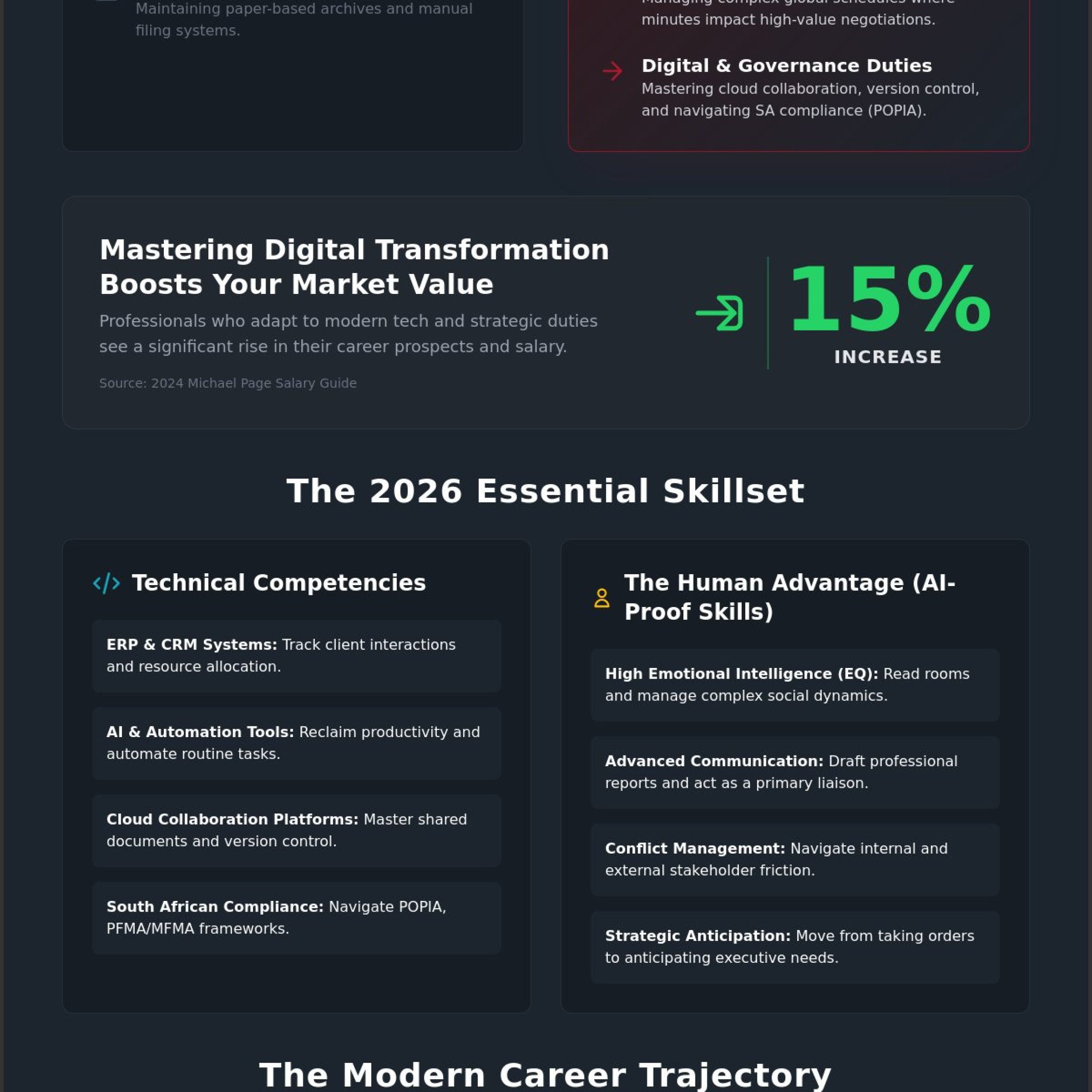
It’s time to stop making excuses for a stagnant career path. You deserve to move beyond the confusion of PA and EA titles into a position of real influence. According to the 2024 Michael Page Salary Guide, administrative professionals in South Africa who master digital transformation see a 15% increase in their market value. This guide delivers the exact roadmap to transform your daily routine into a high-value asset for any boardroom. We will analyze the 2026 responsibility checklist, the essential tech skills required for the local market, and the specific career moves that lead to a promotion.
Key Takeaways
- Stop settling for basic administrative support and learn to transform into the “organizational engine” that drives strategic business success.
- Master the evolving duties of a secretary by integrating complex multi-timezone scheduling with elite professional communication protocols.
- Secure your organization’s integrity by navigating South African compliance standards, including POPIA and advanced project milestone management.
- Command the unique regulatory demands of the South African market by understanding the critical differences between private sector roles and PFMA/MFMA frameworks.
- Eliminate your skills gap through continuous professional development to transition from a task-oriented role to a high-impact strategic partner.
Defining the Modern Secretary: More Than Just Administration
Stop viewing the secretary as a passive support figure. By 2026, this role has transformed into the high-performance engine of the South African workplace. It’s no longer about merely answering phones or filing papers. It’s about maintaining the structural integrity of a business. A secretary ensures that institutional memory doesn’t vanish when a project ends. They’re the gatekeepers of time and the architects of workflow efficiency. Without this role, the system collapses into chaos.
The duties of a secretary have expanded far beyond the traditional scope. We see a clear hierarchy in modern South African firms. General secretaries handle the foundational logistics. Personal Assistants (PAs) focus on the individual needs of a manager, and mastering personal assistant duties is what separates those who merely support from those who drive strategic outcomes. Executive Assistants (EAs) act as strategic partners, often making high-level decisions on behalf of leadership. Each tier requires a different level of discipline and a total commitment to the company’s long-term transformation.
The Evolution of the Role
The era of shorthand and heavy typewriters is dead. In 2026, the transition to digital-first coordination is complete. Secretaries now command cloud-based collaboration tools and AI-driven automation systems to reclaim hours of lost productivity. They’ve moved from being employees who take orders to strategic partners who anticipate needs. They protect executive focus by filtering noise and managing the relentless flow of digital communication. This shift requires a “no excuses” mindset and a relentless drive for results. You don’t just fill a seat; you drive the mission forward.
Core Competencies Required
Technical skill is the baseline. It isn’t the ceiling. You must master ERP and CRM systems to track every client interaction and resource allocation within the South African regulatory framework. However, the real value lies in emotional intelligence. High EQ allows a secretary to read a room, manage conflict, and navigate the complex social hierarchies of a corporate office. These soft skills remain the only part of the job that AI cannot replicate. The modern secretary is a multi-disciplinary coordinator of human and digital resources. They don’t just manage tasks; they manage the system that drives growth. Success in this role isn’t about luck. It’s about fegyelem (discipline) and the willingness to leave your comfort zone every single day.
Core Administrative Responsibilities: The Pillars of Office Efficiency
Efficiency isn’t an accident. It’s the result of disciplined systems. The duties of a secretary in 2026 have shifted from simple support to high-stakes operational management. You handle the friction so the executive can focus on the fire. This starts with managing complex, multi-timezone calendars where a five-minute overlap can derail a R50,000 negotiation. You aren’t just booking slots; you’re protecting the most valuable asset in the company: time.
Modern document management requires more than just folders. You need mastery over version control and digital filing systems that ensure 100% data integrity. The strategic evolution of the secretarial role demands that you act as a technical lead for the office’s digital infrastructure. If a contract version is lost, the momentum stops. You don’t let that happen. You maintain the archives with military precision.
Effective Communication Management
Screening calls is the baseline. In 2026, you’re managing digital noise across multiple platforms. You filter the chaos. Your job is to draft professional reports and external communications that reflect the brand’s authority. You’re the primary liaison. When internal departments or external stakeholders need answers, they come to you. You provide clarity, not more questions. Use Basa Training’s communication frameworks to ensure your message always lands with impact.
Meeting and Event Coordination
Meetings without results are a waste of resources. You drive the outcome by preparing agendas that force decisions. In South Africa, hybrid board meetings are the standard. You must manage the logistics of physical boardrooms in Sandton or Cape Town while ensuring virtual participants have seamless access. Follow-up is where most fail. You track action items with a 0% margin for error. If a task isn’t documented and assigned by the end of the day, the meeting was a failure.
Office Resource and Vendor Management
Procurement isn’t just buying stationery. It involves overseeing service level agreements (SLAs) with vendors to ensure the business gets exactly what it pays for. You manage the R15,000 monthly supply budgets and the R200,000 service contracts with the same level of scrutiny. Integrating administrative skills into these workflows turns a cost center into a lean, productive environment. You own the space, whether it’s a physical floor or a virtual hub. No excuses. Just results.
The Strategic Evolution: Navigating Digital and Governance Duties
The passive assistant role is dead. By 2026, the duties of a secretary require a total shift from clerical support to high-stakes strategic operations. You aren’t just filing papers anymore; you’re managing the organizational pulse. This evolution demands mastery over data, finance, and project milestones. Stop tracking tasks and start driving results. Mediocrity has no place in the modern office.
Financial administration in the South African context has become more rigorous. You’re responsible for handling petty cash, often reaching R10,000 monthly, and overseeing departmental budgets that can fluctuate by R50,000 or more. Precision is the only acceptable standard. Project management has also moved beyond simple lists. You must now navigate milestone management, ensuring every project phase aligns with the company’s quarterly targets and budgetary constraints. If a project stalls, it’s your job to identify the bottleneck before it impacts the bottom line.
AI and automation are the tools that allow you to reclaim your calendar. By automating transcription and scheduling, you can save up to 15 hours every week. This isn’t free time; it’s strategic time. Use it to analyze data or improve internal workflows. Efficiency is about doing more with less effort but with higher impact. You don’t work for the tools; the tools work for you.
Governance and Compliance Oversight
Compliance is your fortress. In South Africa, the Information Regulator enforces POPIA with absolute strictness. A single data breach can cost a firm up to R10 million in fines or result in prison sentences. You must ensure all documentation meets these legal requirements while aligning with King IV governance standards. Ethical leadership and total confidentiality are your non-negotiables. You’re the shield that protects the organization from regulatory failure and reputational damage.
Leveraging Technology for Productivity
Digital presence management is now a core competency. The modern duties of a secretary include commanding platforms like Slack, Microsoft Teams, and Trello to maintain seamless internal communication. Use AI tools for real-time transcription and deep data analysis to provide insights that your executives haven’t seen yet. AI enhances, rather than replaces, the strategic secretary by removing the burden of repetitive tasks and allowing for human-centric decision-making. Mastery of these tools separates the survivors from the leaders in the 2026 workplace. Don’t fear the machine; master it.
Industry-Specific Duties: Public vs. Private Sector Nuances
Your environment dictates your strategy. A secretary in a South African government department operates on a completely different frequency than one in a Sandton boardroom. You must adapt your skills to the specific demands of your sector or risk becoming obsolete. Excellence isn’t universal; it’s contextual. You need to master the specific regulations and performance metrics that govern your specific field.
Administrative Duties in the Public Sector
In the public sector, compliance is your primary metric for success. You don’t have the luxury of “moving fast and breaking things.” You operate within the strict boundaries of the Public Finance Management Act (PFMA) of 1999 and the Municipal Finance Management Act (MFMA) of 2003. These frameworks demand absolute precision in administrative tasks and financial reporting. The duties of a secretary in this space involve maintaining a transparent trail for every decision made.
- Protocol Adherence: You must respect bureaucratic reporting lines. There are no shortcuts through the hierarchy.
- Records Management: You handle public documents that are subject to strict transparency requirements and audits.
- Human Capital: Efficiency in government admin relies heavily on strategic human resource management to align staff output with departmental goals.
Corporate and Executive Support
The private sector demands a focus on the bottom line. Here, the duties of a secretary shift toward maximizing the executive’s time and protecting the company brand. You’re a gatekeeper and a strategist. If an executive is flying to London for a merger, you don’t just book a seat. You manage a complex R250,000 international itinerary where every minute is optimized for ROI. You aren’t just taking notes; you’re synthesizing data to support board-level decisions.
Private sector secretaries must manage investor relations with high emotional intelligence. You represent the brand in every email and call. Your ability to research market trends and present them concisely can be the difference between a signed deal and a missed opportunity. There’s no room for “good enough” when millions of Rands are at stake. Understanding the full scope of personal assistant duties in a corporate environment is essential for anyone looking to transition into executive support at this level.
Specialized Professional Fields
Specialization is the ultimate career insurance. If you work in a law firm, your duties include managing strict court filing deadlines where a one-minute delay can ruin a case. In the medical field, you’re the guardian of patient confidentiality under POPIA regulations. Engineering secretaries must master technical documentation and project management software. Don’t just be a generalist. Master the nuances of your niche to become indispensable.
Stop making excuses for a stagnant career and start leading from the front. Transform your professional impact with Basa Training and master the discipline required for 2026.
Mastering Professional Excellence: Bridging the Skills Gap
The South African job market doesn’t reward mediocrity. By 2026, 40% of the core skills required for administrative roles will have shifted toward technical and strategic competencies. If your daily routine looks exactly like it did two years ago, you’re losing ground. The duties of a secretary have expanded far beyond managing diaries and answering phones. You’re now expected to be a gatekeeper, a project coordinator, and a digital workflow expert.
Continuous Professional Development (CPD) isn’t a luxury; it’s survival. Identifying your personal skills gap is the first step toward a total professional transformation. Moving from basic administration to advanced management requires a massive mindset shift. You’ve got to stop seeing yourself as support staff and start acting like a strategic partner. Specialized training is the fastest way to increase your market value. In South Africa, certified professionals often command salaries 15% to 22% higher than their untrained peers. The BASA approach focuses on this exact transition, turning administrative workers into high-value assets.
Pathways to Career Advancement
You aren’t stuck in your current role unless you choose to be. Transitioning from a Secretary to an Office Manager or Executive Assistant requires a deliberate strategy. You must leverage short courses to gain high-impact skills in weeks, not years. Don’t just list tasks on your resume. Build a skills-based CV that proves you can handle budget oversight and team leadership. This is how you secure career mobility in a competitive economy where results matter more than years of service.
Why Advanced Training Matters
Mastering the duties of a secretary in 2026 means gaining subject matter expertise in finance, HR, and leadership. You need to understand how a balance sheet works and how South African labor regulations impact your office operations. Enrolling in advanced secretarial courses is the most direct path to bridging the gap between back-office support and boardroom-level influence. Networking with peers across Southern Africa allows you to share best practices and stay ahead of regional trends. It’s about building a system of discipline and excellence that makes you indispensable.
Don’t settle for average. Don’t make excuses about lack of time. Take control of your trajectory right now. The difference between a job and a career is the effort you’re willing to invest in yourself.
Master Your Professional Transformation for 2026
The administrative landscape in South Africa is moving fast. By 2026, the standard duties of a secretary will move beyond basic coordination into the realms of digital governance and strategic partnership. You can’t afford to stay stagnant while the corporate world evolves. Success requires a commitment to discipline and a refusal to settle for mediocrity. It’s time to trade outdated habits for a system of professional excellence that delivers measurable results in the boardroom.
BASA Training has been at the forefront of this shift since 2011. We’ve trained over 5,000 delegates using expert-led instruction from subject matter specialists who know exactly what the local market demands. Our programs offer the flexibility you need through comprehensive e-learning and intensive in-person workshop options. Don’t wait for the future to happen to you. Take control of your career path today and view BASA’s Advanced Secretarial and Administrative Skills Workshops to start your transition. Your growth is a choice. Make the right one now.
Frequently Asked Questions
What is the primary difference between a secretary and a personal assistant?
A secretary manages the operational systems of an entire department, while a personal assistant focuses on the specific needs of one executive. In South Africa, 70% of administrative roles now overlap, but the core distinction remains the scope of the work. Secretaries ensure the office engine runs smoothly. PAs manage private logistics, personal travel, and individual schedules to keep a leader focused on high-level decisions.
Can a secretary be promoted to a management position?
You can definitely transition into management if you master the strategic duties of a secretary. Data from 2023 shows that 15% of South African office managers began their careers in entry-level secretarial roles. Your path requires moving beyond basic tasks into resource allocation and team leadership. Stop viewing the desk as a final destination; treat it as a command center for your career transformation.
What are the most important digital tools for a secretary in 2026?
Success in 2026 requires total mastery of AI-driven platforms like Microsoft Copilot and advanced CRM systems like Salesforce. You must automate 40% of your manual data entry using tools like Zapier or Power Automate. If you aren’t using real-time collaborative platforms like Slack or Trello, you’re already behind the curve. These tools aren’t optional extras; they’re the foundation of modern professional efficiency.
Do I need a university degree to perform the duties of a secretary?
You don’t need a four-year degree to start, but you do need proven skills and discipline. While a National Diploma in Management Assistant (NQF Level 6) is highly valued in South Africa, 60% of employers prioritize practical certifications and software proficiency. Results matter more than a piece of paper. Invest in targeted training that proves you can handle the pressure of a high-stakes office environment without making excuses.
How has the POPI Act changed secretarial duties in South Africa?
The Protection of Personal Information (POPI) Act has transformed the duties of a secretary into a high-stakes legal compliance role. Since July 2021, you’re legally responsible for how client data is captured, stored, and deleted. Failure to comply can lead to corporate fines of up to R10 million. You aren’t just filing papers; you’re the frontline guardian of your company’s data integrity and legal safety.
What is the average salary for an advanced secretary in South Africa?
An advanced secretary in South Africa can expect an average annual salary ranging from R280,000 to R450,000 according to 2024 market data. Top-tier executive secretaries in major hubs like Sandton or Cape Town often earn salaries exceeding R600,000 per year. These figures depend on your ability to manage complex projects and high-level stakeholder relations. Your paycheck reflects the level of responsibility you’re willing to shoulder.
How can a secretary help with project management?
Secretaries drive project success by managing timelines and coordinating cross-functional communication. You act as the glue that keeps 100% of project milestones on track through proactive follow-ups. By using Gantt charts and tracking deliverables, you free up the leadership team to focus on growth strategy. Don’t just watch the project happen; lead the workflow and ensure every deadline is met with precision.
What are the ethical responsibilities of a secretary regarding confidentiality?
Your ethical responsibility is absolute; you’re the vault for the company’s most sensitive information. This includes protecting trade secrets, board minutes, and personal payroll data from any unauthorized eyes. A single breach of trust can end your career instantly. In 2026, confidentiality isn’t just a soft skill; it’s a measurable performance metric that defines your professional character and integrity.