

What if your current qualifications are the very thing holding your department back? By 2026, the World Economic Forum predicts that 44% of core professional skills will be disrupted, leaving those with static degrees behind. You’ve likely noticed that theoretical knowledge doesn’t translate to executive execution in the complex SADC regulatory environment. You’re busy, your time is a finite resource, and you can’t afford to waste it on academic fluff that doesn’t move the needle.
This guide changes your trajectory. You’ll master the selection of high-impact short courses designed to bridge the gap between theory and the aggressive demands of the modern South African economy. We’re stripping away the excuses and focusing on recognized certifications that deliver immediate applicability. We’ll preview the essential training frameworks that drive measurable departmental efficiency and ensure your professional transformation is backed by hard results rather than just another certificate on the wall.
Key Takeaways
- Discover how to select high-impact short courses that transform niche expertise into a competitive advantage in the 2026 SADC job market.
- Learn why mastering financial literacy is no longer optional for leaders who want to bridge the gap between management and executive influence.
- Stop falling for the “piece of paper” trap by evaluating facilitator experience over mere accreditation to ensure real-world results.
- Identify how to align training with organizational strategy to calculate tangible ROI and bridge critical departmental performance gaps.
- Adopt a “no excuses” mindset to professional development that replaces fleeting enthusiasm with the disciplined execution required for true transformation.
The 2026 Landscape of Professional Short Courses in Southern Africa
The 2026 job market doesn’t care about your 2015 degree. It rewards speed, precision, and the ability to solve immediate problems. Professional short courses have evolved from optional add-ons into high-intensity, targeted interventions. They’re designed for rapid skill acquisition, turning a generalist into a niche expert in a matter of days or weeks. In South Africa, the traditional multi-year academic route is often too slow to keep pace with industry shifts. Professionals now treat their careers like a high-performance engine; they don’t wait for a total overhaul when a precision tune-up delivers faster results.
Continuous Professional Development (CPD) is no longer a box-ticking exercise for HR. It’s a survival strategy for executives. Stagnation is the enemy. If you’re not actively narrowing your focus to high-value expertise, you’re becoming obsolete. South African leaders are ditching the broad “management” labels for specific certifications that prove they can handle the unique economic pressures of 2026. Results are the only currency that matters now.
The Evolution of Upskilling
Technological disruption across the SADC region has slashed the half-life of professional skills to roughly 2.5 years. What worked in 2023 is a liability today. We’ve moved toward modular learning where you build a stackable qualification profile. You need to understand what are microcredentials to realize how they fit into this new world. Attendance is a participation trophy; transformation is the benchmark. If a course doesn’t change how you work on Monday morning, it’s a waste of your time and capital. You don’t need more information; you need better systems and the discipline to execute them.
Public vs. Private Sector Training Needs
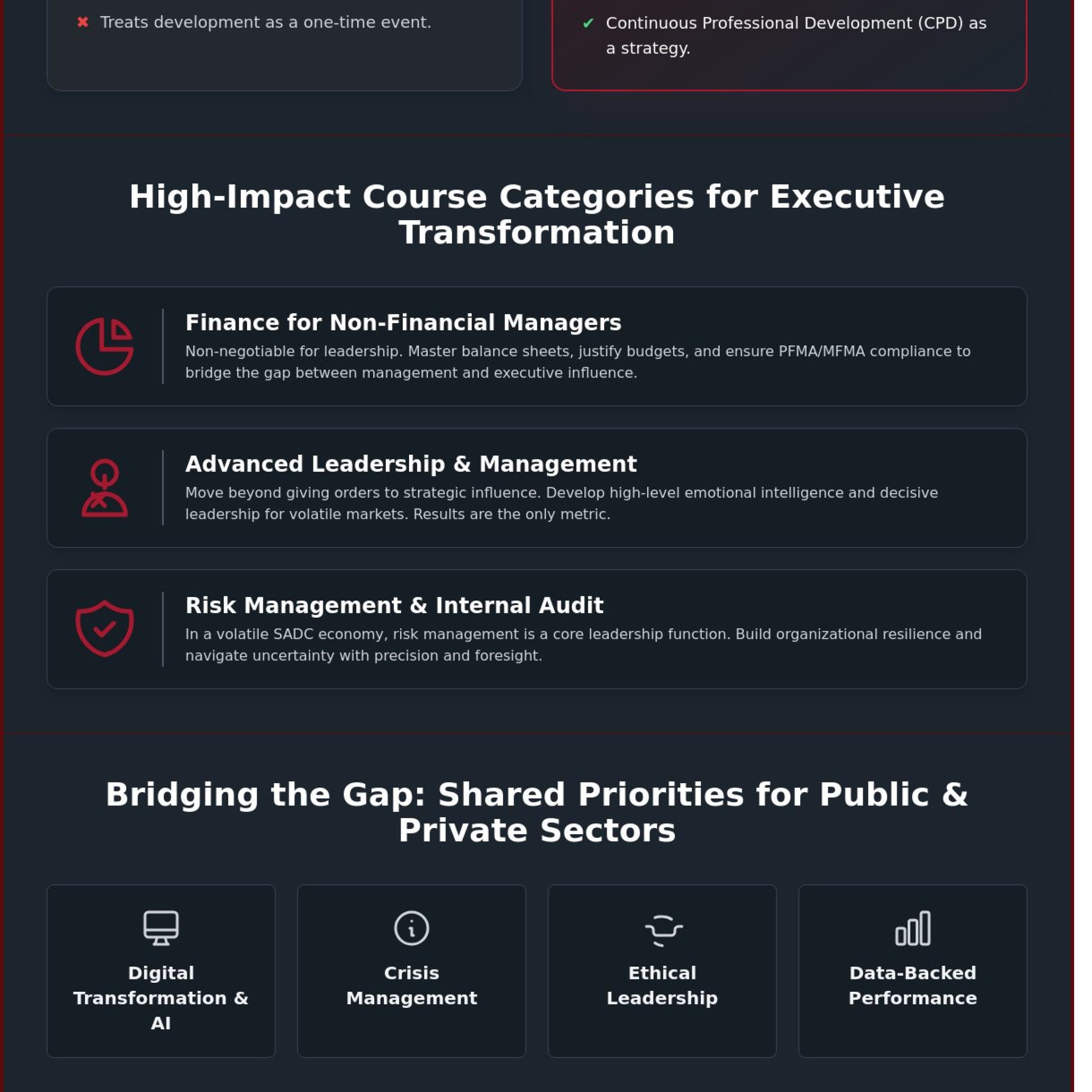
The divide between sectors is narrowing, but the pressure points remain distinct. Public sector officials face rigorous compliance and governance requirements, often dictated by the Public Finance Management Act (PFMA). Their training must focus on clean audits and transparent service delivery. In contrast, the private corporate environment demands strategic leadership and aggressive market adaptation. Despite these differences, certain short courses bridge the gap perfectly. Both sectors currently prioritize:
- Digital transformation and AI-driven decision making.
- Crisis management and organizational resilience.
- Ethical leadership in high-pressure environments.
- Data-backed performance tracking.
Don’t settle for mediocre training that offers “general insights.” Demand a system that forces growth. Whether you’re navigating state-owned enterprise complexities or scaling a private firm, the goal remains the same: radical improvement through disciplined learning. The time for excuses is over. The 2026 landscape belongs to those who act while others are still “considering their options.”
High-Impact Short Course Categories for Career Advancement
Stop waiting for permission to lead. In 2026, the gap between a standard manager and a high-impact executive is bridged by specialized, technical competence. These short courses act as tactical upgrades for professionals who refuse to settle for mediocrity. If you want to influence the boardroom, you must master the mechanics of the business first.
Every manager needs to speak the language of numbers. If you can’t read a balance sheet or justify a budget, you’re a liability. This is why a finance for non financial managers course is non-negotiable for anyone eyeing a promotion. In the South African public sector, this requirement is even more rigid. Precision in budgeting and reporting under the MFMA and PFMA frameworks determines professional survival. You don’t just need to know the rules; you need to master the execution.
Advanced Leadership and Management
Modern leadership isn’t about giving orders. It’s about strategic influence. A high-tier leadership development program focuses on emotional intelligence and decision-making in volatile markets. Executive leadership is a discipline of consistent results rather than just a title. You must learn to navigate complexity without losing sight of the bottom line. Transformation starts with your ability to pivot when the market shifts.
Risk Management and Internal Audit
The 2024 IRMSA Risk Report highlighted that South African businesses face unprecedented volatility. By 2026, risk management has evolved from a compliance checkbox into a strategic advantage. You need to develop frameworks that ensure organizational resilience and ethical governance. Moving from reactive auditing to proactive mitigation is the only way to protect assets. Professionals who can predict and neutralize threats are the most valuable players in any organization.
Supply Chain and Logistics
Logistics in the SADC region require more than just basic planning. They demand a deep understanding of modern methodology and regional challenges. Optimizing the supply chain management and logistics lifecycle is now a digital-first game. Digitization has completely overhauled procurement and fleet management. If your systems are manual, you’re losing money. Efficiency is the only metric that matters when margins are tight. Professionals managing vehicle assets across the region should consider a fleet management course to master telematics, cost reduction, and SADC cross-border compliance. You can explore our professional curriculum to see which operational track fits your career trajectory.
- Project Management: Project Management Professional (PMP) certification is the gold standard for operational excellence.
- Strategic Thinking: Moving from daily tasks to long-term value creation.
- Operational Auditing: Ensuring every process contributes to the final goal.
Don’t let your skills expire. The 2026 market doesn’t reward those who stay comfortable; it rewards those who adapt. Choose a path, commit to the work, and own your professional transformation.
Evaluating Short Courses: Beyond the Certificate of Attendance
Stop collecting participation trophies. A certificate of attendance is a low bar that won’t save your career in 2026. If you want real transformation, you must look past the “piece of paper” trap. Accreditation is simply the floor. It guarantees a minimum standard, but it doesn’t guarantee your mastery. You need short courses that force you out of your comfort zone and demand measurable output. Results matter. Everything else is just noise.
Accreditation and Quality Assurance
Verify every provider through the South African Qualifications Authority (SAQA) database. Check if the programme aligns with the National Qualifications Framework (NQF) and carries SETA accreditation. Don’t confuse attendance with competence. A certificate of competence requires you to prove your skills through rigorous assessment. In a competitive market, 92% of hiring managers prioritize verified competence over simple workshop attendance. Do your homework. Verify the provider’s accreditation number before paying a single Rand. If the provider isn’t transparent about their credentials, walk away.
The Workshop Experience vs. Online Learning
Online modules work for technical updates, but they often fail at deep leadership transformation. Complex fields like strategic human resource management thrive on face-to-face friction. You need to look your peers in the eye. You need to role-play high-stakes negotiations and dissect real-world case studies in real-time. This consultative approach turns a standard lesson into a strategic intervention. Research shows that 78% of professionals retain more information when they engage in peer-to-peer learning in a physical classroom setting.
Evaluate the facilitator’s scars, not just their slides. If they haven’t managed a crisis in the last 24 months, they’re teaching history, not strategy. Demand facilitators with active industry experience. Theoretical knowledge is cheap, but execution is rare. The networking dividend of a public workshop is often worth more than the curriculum itself. You’re not just buying knowledge; you’re buying access to a network of disciplined professionals who are as hungry for results as you are.
Check the curriculum for practical tools. If the short courses you’re considering don’t offer frameworks for immediate implementation on Monday morning, you’re wasting your time. A high-value programme includes:
- Implementation toolkits and templates.
- Post-course support or follow-up sessions.
- Direct feedback on your specific business challenges.
- Peer-reviewed case study analysis.
Don’t settle for mediocre training. Choose a system that demands your best and provides the tools to achieve it. Transformation requires work, discipline, and the right mentors.
Aligning Short Courses with Organisational Strategy
Strategy isn’t a suggestion; it’s survival. HR managers in 2026 cannot afford to treat professional development as a checkbox exercise. When a department misses its targets, the cause is usually a specific performance gap that generic degrees won’t fix. Targeted short courses provide the surgical precision needed to bridge these voids. You don’t need your team to know everything; you need them to master the three things that drive your bottom line right now.
Calculating the ROI of training requires a shift from “cost per seat” to “value per output.” If a training module for a project manager costs R12,000 but results in a 20% reduction in project delivery time, the investment pays for itself within the first quarter. Productivity increases are measurable metrics, not abstract concepts. Stop looking at the invoice and start looking at the efficiency gains. Customised in-house training allows you to bake internal policy and South African regulatory frameworks directly into the curriculum, ensuring that the theory aligns with your specific operational reality.
Human Capital Development
Identify your mission-critical skills today. If your workforce lacks the technical agility to handle 2026 market shifts, your organisation is already falling behind. We build a culture of fegyelem (discipline) where continuous improvement is the standard, not the exception. For those in the state-owned sector, leveraging public sector training workshops is the most direct route to building institutional capacity and ensuring service delivery excellence. Pairing this with a robust monitoring and evaluation framework ensures that every training investment is tracked against real organizational outcomes.
The Budgeting for Training
Allocating resources in a constrained economy requires a ruthless focus on impact. Don’t spread your budget thin across “nice-to-have” soft skills. Instead, concentrate your spend on high-impact short courses that solve immediate bottlenecks. When motivating for spend to executive committees or municipal boards, speak the language of assets. Training is a capital investment in human assets, not an operational expense. You’re not spending money; you’re upgrading the engine of your business to prevent the massive costs of stagnation or incompetence.
Succession planning is where strategy meets foresight. Don’t wait for a senior vacancy to scramble for talent. Use intensive training blocks to prepare junior managers for the weight of leadership. It’s significantly more cost-effective to upskill a proven internal performer than to risk a R300,000 recruitment fee on an external hire who might not fit your culture. Build your leaders; don’t just buy them.
Ready to transform your workforce into a high-performance machine? View our results-driven corporate training solutions.
The BASA Transformation: Expert-Led Professional Development
Business Academy Southern Africa (BASA) isn’t for those seeking a participation trophy. It’s for SADC leaders who demand measurable ROI and professional growth. We’ve built our reputation on a “No Excuses” philosophy. We value fegyelem (discipline) because motivation fades, but systems endure. This approach has made us the primary choice for public sector departments and private enterprises across South Africa. We don’t just offer training; we provide a roadmap for total professional transformation.
Our short courses bridge the gap between theoretical knowledge and operational reality. We cover everything from Advanced Secretarial Skills for executive support staff who are mastering the evolving duties of a secretary to complex Monitoring and Evaluation frameworks for project managers. These aren’t just lectures. They’re strategic interventions designed to fix real problems. Whether you’re navigating the South African regulatory environment or streamlining supply chain logistics, BASA provides the tools to execute with precision. Organisations serious about retaining clients and reducing churn should also explore our training in customer service excellence, a non-negotiable competency in the 2026 market where a single service failure can cost you a loyal customer.
Our Subject Matter Experts
A BASA facilitator brings a minimum of 15 years of industry-specific experience to the room. They’ve managed the budgets and led the teams they’re now training. We provide a consultative edge; we advise while we teach. This hands-on expertise has led to documented 40% improvements in administrative efficiency for our long-term partners. Our facilitators don’t settle for mediocrity. They push delegates to leave their comfort zones and adopt a mindset of sustainable excellence. We don’t just teach the curriculum; we share the scars and successes of real-world implementation.
Taking the Next Step
Transformation requires immediate action. Review our 2026 course calendar to find scheduled public workshops in major hubs like Johannesburg, Cape Town, and Durban. If your team has specific gaps, request a customized training proposal tailored to your organisational DNA. The registration process for individual delegates is streamlined and efficient. Complete the digital form, secure your seat, and prepare for a rigorous learning experience. Stop waiting for the perfect moment. It doesn’t exist. You have to work for the results you want.
The 2026 business environment will be unforgiving to those who stop learning. By choosing BASA, you’re investing in a system that prioritizes results over rhetoric. Our short courses are the catalyst for the next phase of your career. Don’t let another year pass without a clear plan for your professional evolution. The tools are here. The experts are ready. The only remaining variable is your commitment to the process.
Own Your Professional Evolution in 2026
The 2026 professional landscape in Southern Africa doesn’t have room for spectators. Success requires a deliberate shift from passive learning to aggressive, strategic execution. You’ve seen that high-impact short courses are no longer just about filling a CV. They’re about aligning your personal skill set with the rigorous demands of organizational strategy. Since 2011, we’ve helped thousands of professionals across both the public and private sectors bridge the gap between theory and real-world application. We don’t do fluff. We do transformation.
Mediocrity is a choice you can’t afford. Our expert-led workshops are designed for those who value discipline over empty promises. Whether you’re navigating the complexities of the South African market or leading a team through rapid industry shifts, your results will always reflect your level of preparation. It’s time to step out of your comfort zone and into a system built on a proven track record of excellence. The tools for your advancement are ready. The only question is whether you’re ready to use them.
Explore our 2026 Short Course Calendar and book your seat today
Your future career isn’t something that happens to you. It’s something you build with every decision. Make the right one today.
Frequently Asked Questions
What are the most in-demand short courses in South Africa for 2026?
Data analytics, cybersecurity, and renewable energy management are the top three in-demand fields for 2026. The World Economic Forum’s Future of Jobs Report predicts that 44% of workers’ skills will be disrupted by 2027. In South Africa, specialized short courses in solar installation and AI integration are essential for survival. Don’t waste time on outdated theories. Focus on these high-growth sectors to secure your market value today.
How long do professional short courses usually take to complete?
Most professional programs take between 2 days and 6 months to complete. Intensive workshops deliver results in 48 hours, while technical certifications require 12 weeks of disciplined study. Your schedule isn’t an excuse. These formats respect your time while demanding total focus. Choose a duration that matches your transformation goal. Speed matters, but mastery is the priority.
Can I use short courses to change my career path entirely?
You can pivot your career using targeted short courses to bridge specific skill gaps. Transitioning from administrative roles to data analysis requires a 3-step certification path. Statistics from LinkedIn’s 2024 Global Talent Trends show that 73% of hiring managers prioritize skills over traditional degrees. Stop dreaming about a change. Build a portfolio of specific competencies and force the market to take notice.
Are short courses recognised by South African employers?
South African employers value any certification that carries SETA accreditation or international industry backing. According to the 2024 South Africa Salary Survey by Robert Walters, 65% of local firms prefer candidates with recent, practical upskilling. They want proof of performance, not just paper. Ensure your provider is registered. Real-world skills are the only currency that matters in the boardroom.
What is the difference between a short course and a full qualification?
A full qualification covers a broad NQF level over 3 years, while a short course targets one specific skill in weeks. Think of the full degree as the foundation and the short course as the specialized weapon. You don’t need a new degree to master project management. You need a system. Use short programs for rapid adaptation and full qualifications for deep academic grounding.
How do I choose between a public workshop and in-house training for my team?
Choose in-house training if you have more than 8 team members needing a unified strategy. It’s cost-effective and focuses on your specific business hurdles. Public workshops are better for individual high-performers who need fresh external perspectives. Don’t settle for generic solutions. Analyze your team’s output. If the system is broken, fix it internally with a customized program. Teams that interact directly with clients should also consider building a foundation in customer service excellence to protect revenue and reduce brand-damaging churn.