

Your decade of experience is worthless if your CV still reads like a 2019 job description. In 2026, the South African job market doesn’t care about how long you’ve sat at a desk; it cares about the specific problems you can solve right now. You’ve likely felt that stagnation in your current mid-level role, wondering which skills for cv are still relevant in an AI-driven economy. It’s a frustrating position to be in when you know you’re capable of more but can’t seem to break through the ceiling.
Stop making excuses for a stagnant career. This guide will show you exactly how to master the 2026 job market and evidence your value with absolute authority. You’ll gain total clarity on the professional short courses needed to bridge your gaps and learn the data-driven methods to quantify leadership impact for R95,000 a month management roles. We’re breaking down the technical must-haves and the soft skill frameworks that pass both ATS filters and human scrutiny with ease.
Key Takeaways
- Understand why the South African corporate landscape is shifting toward a skills-first hiring model and how to define your professional value.
- Master the synergy between hard technical proficiency and high-level emotional intelligence to secure leadership roles in 2026.
- Identify the 10 most critical skills for cv that South African employers in both the public and private sectors demand right now.
- Apply the STAR method to transform empty buzzwords into undeniable, provable results that demonstrate your impact with authority.
- Learn how to conduct a ruthless self-audit to identify skill gaps and commit to the discipline of lifelong learning for career transformation.
The 2026 Job Market Shift: Why Your Skills Section is Your Most Valuable Asset
The South African corporate landscape has undergone a brutal transformation. The era of “experience-first” hiring is dead. In 2026, hiring managers in hubs like Sandton and Century City no longer care about how many years you sat at a desk. They care about what you can actually do. Your skills for cv section is no longer a footnote; it’s the engine of your professional value. If you’re still leading with a list of vague job titles from five years ago, you’re invisible to the market.
CV skills are the specific, provable competencies that allow you to execute tasks and lead teams with precision. These aren’t aspirations. They’re tools. In a high-stakes economy, businesses demand a return on their investment. They want to see a “discipline-driven” profile that reflects constant growth. A static CV is a career-killer. You either evolve your skill set or you get left behind by those who treat their professional development like a rigorous training system.
Applicant Tracking Systems (ATS) have become more aggressive. By 2026, these algorithms prioritize skill density over traditional prestige. If your document doesn’t hit the required technical benchmarks, it’s discarded before a human recruiter even sees your name. High-performing candidates understand that their employability skills must be visible, measurable, and current. Success requires a strategic update of your competencies every six months to stay relevant.
The Rise of Skills-Based Hiring
Top-tier South African firms now value verified short-course certifications as much as traditional degrees. Data from 2025 indicates that 68% of local recruiters prioritize specific technical certifications over generic diplomas. They look for “skill clusters.” This means demonstrating how your abilities in data analysis, project management, and digital literacy work together to solve complex problems. You must identify the transformation potential of your current set. Can your skills adapt to a new department tomorrow? If the answer is no, your career is stagnant.
ATS Optimization: The Technical Reality
Modern recruitment software doesn’t just look for words; it understands semantic variants. Using outdated terminology is a red flag that signals a lack of professional discipline. If you’re still listing “team player” instead of “cross-functional collaboration,” the algorithm will penalize you. You must balance human readability with algorithmic requirements. Use sharp, industry-standard language.
- Kill the fluff: Replace “good communicator” with “stakeholder management” or “technical reporting.”
- Be specific: Don’t just list a skill; mention the specific software or methodology used.
- Update keywords: Ensure your skills for cv list matches the specific 2026 terminology for your industry.
The market doesn’t reward effort; it rewards results. Your CV must reflect a commitment to excellence and a refusal to settle for mediocrity. Stop making excuses for an outdated profile. Build a system that keeps your skills sharp and your value high.
Hard Skills vs. Soft Skills: The Professional Transformation Balance
Stop categorizing “soft” skills as secondary. It’s a myth that costs professionals thousands in lost promotions. Technical proficiency gets you the interview, but your ability to lead, adapt, and communicate secures the seat at the boardroom table. In the 2026 job market, the most valuable skills for cv are the ones that are hardest to master. We see too many managers who can code or audit but can’t resolve a team conflict or pivot during a market shift. That’s a failure of discipline, not talent.
High-level leadership requires a hybrid approach. Technical authority provides the foundation; emotional intelligence (EQ) provides the leverage. You need both to drive measurable organizational efficiency. At Basa Training, we view every skill through the BASA perspective: if a competency doesn’t lead to a faster, leaner, or more profitable system, it’s just noise. Your transformation from a tactical worker to a strategic leader depends on balancing these two pillars with uncompromising fegyelem.
Mastering Hard Skills for Technical Authority
Technical authority is your baseline for professional respect. In South Africa, industry-standard certifications act as a gatekeeper for high-earning roles. Earning a Project Management Professional (PMP) designation proves you can manage complex systems under pressure and deliver results on time. Without these credentials, you’re just guessing.
Financial literacy is another non-negotiable requirement. Most managers fail because they don’t understand how their decisions impact the bottom line. Mastering Finance for Non-Financial Managers allows you to speak the language of business. You need to interpret ZAR-based balance sheets and ROI metrics with the same ease you use to check your email. Digital literacy in 2026 has also evolved. It’s no longer about basic software; it’s about data interpretation and IT management governance. If you can’t govern the tools your team uses, you aren’t leading them.
The Power of Durable Soft Skills
Soft skills are durable because they don’t expire when software updates. Research from Harvard University confirms that analytical thinking and active learning are now the most critical emerging competencies for global professionals. You must move from tactical execution to long-term vision. Strategic thinking isn’t a gift; it’s a system you build through practice and awareness.
- Emotional Intelligence: This is a high-performance tool for conflict resolution. Use it to dismantle barriers to team performance.
- Adaptability: The SADC economic environment is volatile. Your ability to navigate rapid changes determines your survival.
- Conflict Management: Stop avoiding difficult conversations. Resolve them quickly to maintain organizational momentum.
Don’t settle for being “good enough” in one area while neglecting the other. To truly optimize your skills for cv, you must prove you can handle the technical rigour and the human complexity of modern business. If you’re ready to build a comprehensive soft skills list that drives professional transformation, explore our professional development tracks to bridge your competency gaps today.
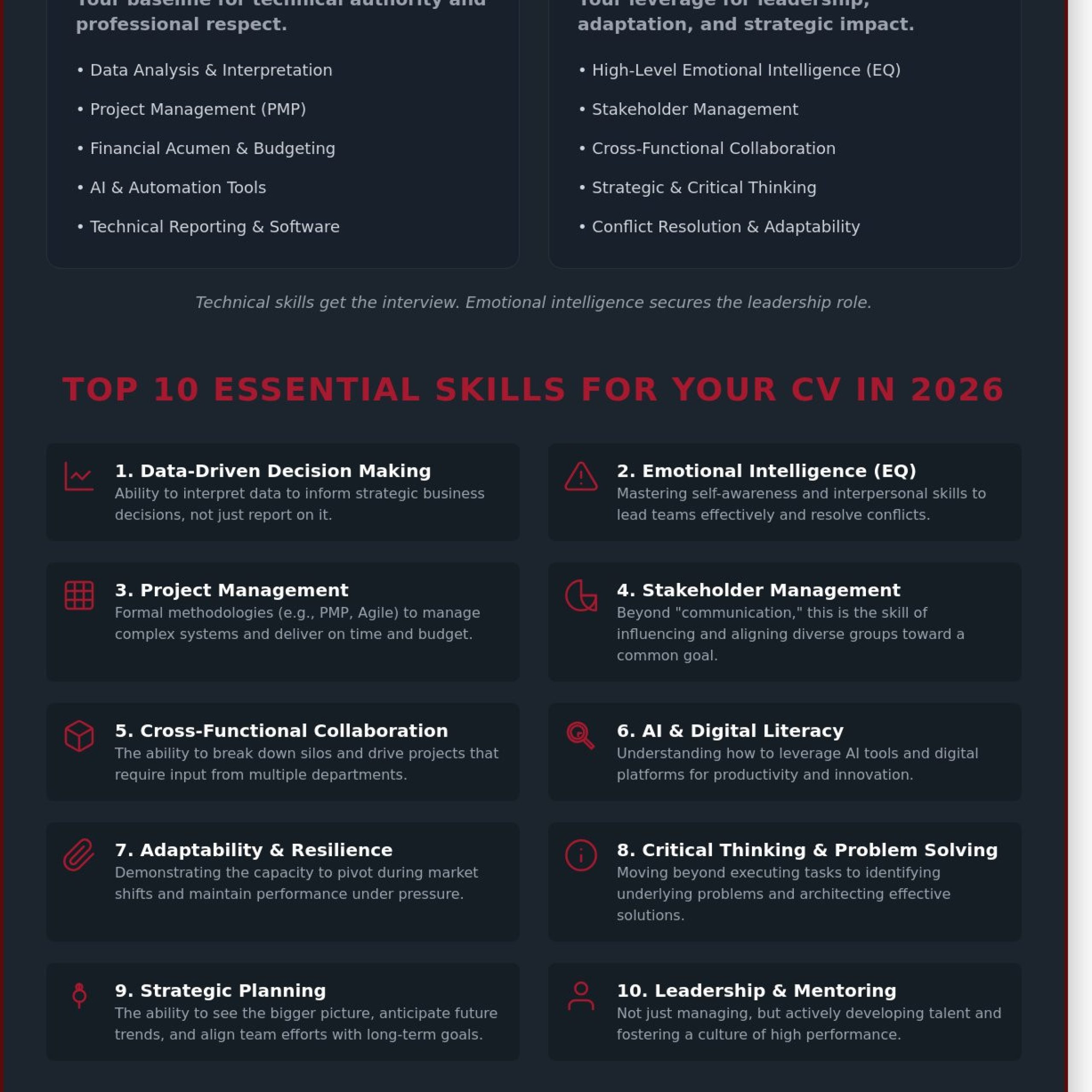
The Essential Skills for CV Checklist: 10 Competencies Employers Demand
Stop filling your professional profile with fluff. In the 2026 South African job market, mediocrity is a career killer. Employers don’t care about your participation; they care about your impact. Your selection of skills for cv determines your market value. If you can’t prove you’ve mastered the following ten competencies, you’re just another name in the pile. You need to show you can handle the pressure of a shifting economy and deliver results that matter.
Leadership and Management Excellence
True leadership isn’t a title. It’s an action. Strategic Planning is your first priority. You must demonstrate that you can design a roadmap that aligns with King IV governance principles. Don’t just say you lead teams. Prove you’ve mastered Change Management. With 70% of organizational shifts failing due to poor execution, showing you can anchor a team through a transition is vital. Finally, master Conflict Resolution. It’s not about being liked. It’s about maintaining workplace harmony to ensure the work gets done without delays.
Operational and Financial Competencies
Numbers don’t lie. If you can’t manage a budget, you can’t manage a department. Budgeting and Financial Reporting are non-negotiable. Whether you’re handling a R500,000 project or a R50 million division, accountability is everything. Supply Chain and Logistics skills have become critical as South African businesses struggle with port efficiencies and global trade shifts. You need to understand the flow of value. Pair this with Project Management skills. Use frameworks like Agile or Prince2 to show you deliver results on time and within the original scope. Efficiency is your only currency.
Administrative and Governance Skills
The backbone of any successful firm is its system. Advanced Secretarial Skills aren’t just about typing; they’re about executive efficiency and gatekeeping. In 2026, the duties of a secretary have shifted entirely from passive administration to aggressive organizational strategy, making these competencies far more valuable than most professionals realize. In the public sector, Compliance is the gold standard. You must navigate the Public Finance Management Act (PFMA) or the Municipal Finance Management Act (MFMA) with precision. Mistakes here lead to audits and lost revenue. Risk Management is your final shield. Identify threats before they hit the bottom line. A professional who anticipates a R2 million loss and prevents it is worth ten times their salary.
Don’t list all ten. That’s a sign of desperation. Choose the top 5-7 skills for cv that align with your 2026 career goals. If you’re aiming for a CFO role, lean into financial reporting and risk. If you want to run operations, double down on logistics and change management. Be surgical. Be precise. Be the candidate they can’t afford to ignore.
Beyond the Buzzwords: How to Evidence Your Skills for Maximum Impact
Stop filling your CV with empty adjectives. In the 2026 South African job market, “motivated” and “hardworking” are just background noise. Professional recruiters and AI-driven ATS systems demand proof. The “No-Excuses” rule is simple: if you can’t evidence your skills for cv with a concrete result, you don’t possess them in the eyes of an employer. You’ve got to move from making claims to providing receipts. Numbers don’t lie, and they’re the only thing that will make your application stand out in a pile of hundreds. Building a skills based cv that prioritizes high-impact competencies over chronological history is the strategic shift that separates candidates who get interviews from those who get ignored.
The STAR Method for Skills Integration
The STAR (Situation, Task, Action, Result) method isn’t just for interviews. It’s the most effective way to draft bullet points that carry weight. Instead of listing “Management” as a skill, describe the specific scenario where you applied it. Focus 80% of your energy on the ‘Result’ phase. This is where you demonstrate your value as a professional asset rather than a cost center. Use these tips to sharpen your bullets:
- Start with a strong action verb like “Engineered,” “Negotiated,” or “Transformed.”
- Identify the specific challenge you faced in your previous role.
- Detail the exact steps you took to solve the problem.
- End with a measurable outcome that benefits the bottom line.
I streamlined the procurement process for a Gauteng-based retail chain, resulting in a 14% reduction in supply chain costs and a direct saving of R280,000 in the 2025 fiscal year.
Certifications as Proof of Competency
Gaps in your work history are red flags unless you fill them with intentional growth. Completing short courses sends a powerful psychological signal to a recruiter. It shows you’ve got a “Continuous Professional Development” mindset and the discipline to upskill without being told. This is especially critical in 2026, where the half-life of technical skills is shorter than ever. You aren’t just showing what you know; you’re showing that you know how to learn.
For those aiming for leadership or corporate roles, specialized training is non-negotiable. Showcasing a qualification in Strategic Human Resource Management proves you understand how to align human capital with business objectives. It moves you from being a generalist to a specialist who can drive performance. Don’t just list your skills for cv in a vacuum. Back them up with accredited training that validates your expertise and justifies a higher salary bracket.
Ready to stop making excuses and start getting results? Invest in your future with Basa Training today and build a career that lasts.
Future-Proofing Your Career: From Skill Gaps to Professional Mastery
The 2026 job market won’t wait for you to feel ready. Complacency is the fastest route to professional obsolescence in South Africa’s evolving economy. You need a plan. You need discipline. Mastery isn’t a gift; it’s the result of a deliberate, often uncomfortable process of self-correction. If your current skills for cv look the same as they did two years ago, you’re already falling behind. Transformation requires you to stop making excuses and start measuring your output against global standards.
Conducting a Personal Skill Gap Analysis
Stop guessing what employers want. Open five job descriptions for your dream roles in Cape Town or Sandton and list every requirement. Compare these against your current profile. Be brutal. If a role requires advanced AI literacy or complex stakeholder management and you only have “basic computer skills,” that’s a high-impact gap. A 2023 World Economic Forum report indicates that 44% of worker skills will be disrupted by 2027. You need a 12-month roadmap that prioritizes these high-impact competencies over low-value fillers. Focus on what moves the needle for your specific industry. Don’t waste time on “soft” skills that lack a measurable outcome. Use a structured soft skills list for professional transformation to ensure you’re targeting the human-centric competencies that employers in 2026 can’t automate away.
The BASA Advantage: Training for Results
We don’t do fluff. Our Leadership Development Program is designed to transform managers into visionary leaders through a “hard but fair” methodology. We bridge the gap between theoretical knowledge and real-world subject matter expertise. You’ll face challenges that push you out of your comfort zone because that’s where growth happens. Our public workshops and in-house training sessions provide the technical edge and psychological toughness required for the 2026 executive landscape. We don’t just teach; we demand excellence and provide the system to achieve it.
Investing in yourself is the only investment with a guaranteed return. South African professionals who commit to lifelong learning now will be the ones holding the keys to the boardroom in 2026. The difference between a mediocre career and professional mastery is the willingness to do the work others won’t. Your updated skills for cv should reflect a commitment to constant evolution. Don’t wait for your company to offer a training budget. Take ownership of your transformation today. The first step is acknowledging where you’re weak and deciding to become strong. Start now.
Stop Guessing and Start Leading Your Career
The 2026 job market doesn’t reward participation; it rewards mastery. You now understand that your skills for cv checklist is a strategic roadmap, not a static list. Success requires a ruthless balance between technical agility and the durable soft skills that machines can’t replicate. Employers across South Africa are looking for candidates who provide evidence of their impact rather than hiding behind tired industry cliches. Since 2011, BASA has been at the forefront of developing human capital, equipping professionals with the tools to dominate their fields. We’ve refined our approach through expert-led workshops across the SADC region, serving both the public and private sectors with uncompromising standards.
The gap between where you are and where you want to be is filled with the work you’re willing to do. Don’t settle for a mediocre career when professional transformation is within your reach. It’s time to stop making excuses and start building a future-proof legacy. Upgrade your skills and transform your career. Explore BASA’s 2026 Workshop Calendar now.
Your next big breakthrough is waiting for you to take the first step. Let’s get to work.
Frequently Asked Questions
What are the most important skills for a CV in 2026?
AI literacy and data-driven decision making are the non-negotiable skills for cv in 2026. According to the World Economic Forum, 44% of workers’ core skills will face disruption by 2027. You must master tools like Power BI for analysis or generative AI for workflow automation. Don’t just list these tools. Show how you used them to drive a 15% efficiency gain in your previous South African corporate role.
How many skills should I list on my CV?
Limit your list to 10 or 15 highly relevant skills that match the job description. A cluttered CV suggests a lack of focus. Recruiters in Johannesburg and Cape Town spend approximately 6 seconds on an initial scan. Select 5 technical hard skills and 5 core interpersonal strengths. This focused approach ensures your profile hits the mark without burying your value under a mountain of fluff.
Is it better to list hard skills or soft skills first?
List your hard skills first to clear the Applicant Tracking System (ATS) filters immediately. Technical proficiency gets you through the digital gatekeeper; soft skills win the interview. In the South African tech and finance sectors, 75% of recruiters use automated filters. Start with your certifications and software expertise. Follow up with the discipline and communication traits that prove you can deliver results in a high-pressure environment.
Can I list skills on my CV if I don’t have a degree in that field?
You can list any skill if you have measurable proof of competence. Results are the only currency that matters in the 2026 job market. If you taught yourself Python and completed a R4,500 professional certification, own that achievement. Mention specific projects where you applied the skill to solve a business problem. A degree is just paper; your ability to perform is a verified asset.
How do I describe my leadership skills on a CV without sounding arrogant?
Describe leadership through the lens of team achievements and hard data. Instead of calling yourself a “visionary leader,” state that you managed a team of 12 to exceed annual targets by 22%. Use verbs like “mentored,” “facilitated,” or “coordinated.” This shows authority without the ego. It proves you have the discipline to lead others toward a collective win rather than just seeking personal glory.
What are ‘durable skills’ and why are they important for my career?
Durable skills are character traits like critical thinking and adaptability that don’t become obsolete as technology changes. While technical skills for cv have a half-life of 5 years, durable skills last your entire career. Research from America’s SuccessX shows these traits appear in 70% of job postings. They are the foundation of your professional transformation. Master them to remain employable regardless of how AI shifts the market.
How do I update my skills section if I am changing careers?
Identify the overlap between your past experience and your new target industry. If you’re moving from retail into project management, focus on your R1.5 million budget oversight and stakeholder coordination. Use the job description as your roadmap. List the transferable skills you’ve already mastered that meet their specific criteria. Every career shift requires a tactical audit of your arsenal. Don’t start from zero; build on your existing discipline.
Do recruiters actually check the skills section of a CV?
Recruiters check the skills section to validate your fit against the job’s specific requirements. It’s the first place they look after scanning your job titles. In South Africa’s competitive R40,000 per month mid-level bracket, missing one key software skill can end your candidacy instantly. They need to see that you have the tools to hit the ground running. No excuses. Either you have the skills or you don’t.