

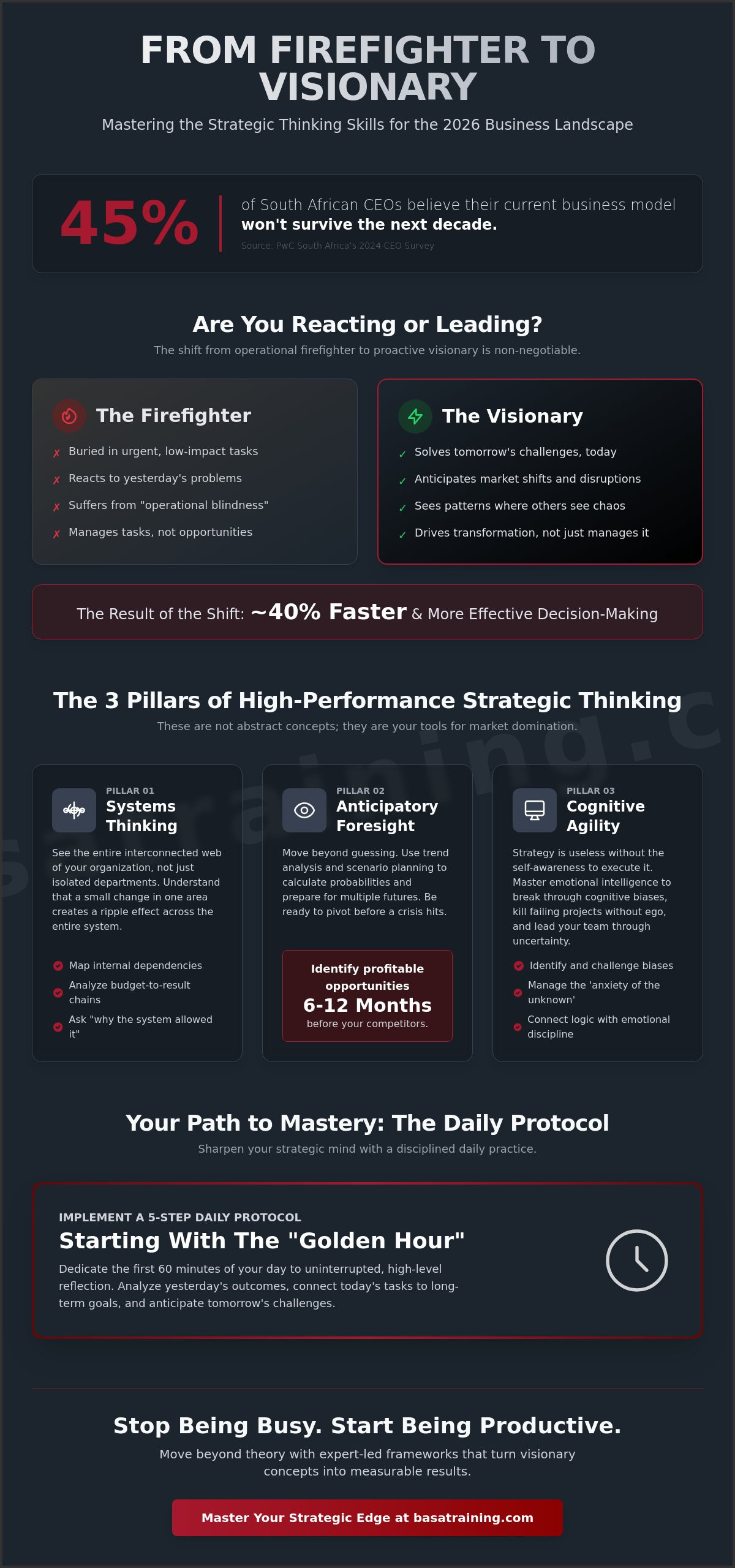
Stop hiding behind your to-do list. According to PwC South Africa’s 2024 CEO Survey, 45% of local leaders believe their current business model won’t survive the next decade. Your hard work is actually your biggest liability if it keeps you stuck in the trenches while the world moves toward 2026. You feel the pressure in every board meeting because your strategic thinking skills have been buried under a mountain of urgent emails. You’re silent because you’re reacting to yesterday’s problems instead of solving tomorrow’s.
It’s time to stop being a firefighter and start being a visionary. You need to master the disciplined mental frameworks required for high-performance leadership to remain relevant in an era of AI and agile competitors. We’re going to strip away the excuses and give you a concrete path to long-term career transformation. This guide breaks down the specific habits that will improve your decision-making speed by 40% and ensure you’re the one driving the transformation, not the one being left behind.
Key Takeaways
- Stop reacting and start leading by mastering the two essential pillars required to navigate the SADC region’s unique market volatility.
- Implement a 5-step daily protocol to sharpen your strategic thinking skills, starting with a disciplined “Golden Hour” of uninterrupted reflection.
- Break the cycle of “operational blindness” by identifying the specific cognitive biases that kill long-term strategy and keep you busy instead of productive.
- Shift from siloed management to a systems-thinking approach, viewing your organization as an interconnected web designed for competitive advantage.
- Move beyond theory with expert-led frameworks that turn visionary concepts into measurable results within the 2026 business landscape.
What are Strategic Thinking Skills in the 2026 Business Landscape?
Stop reacting to the market. Start dictating it. In the 2026 South African business environment, strategic thinking skills are the only filter that matters for high-performance leadership. It’s the intentional, logical evaluation of complex information to secure a long-term competitive advantage. While your peers are stuck fixing yesterday’s mistakes, you must be calculating the next three moves. What is Strategic Thinking? It’s the cognitive discipline that separates the visionary from the executive casualty.
The SADC region faces unique volatility heading into 2026. With the Rand’s historical 12-month volatility often exceeding 15%, simple “planning” is a death sentence. You can’t rely on a static document. You need a mindset that thrives on disruption. Strategic thinking is the “why” behind the “how.” It’s the mental framework that allows you to see patterns where others see chaos. If your career feels stagnant, it’s likely because you’re still managing tasks instead of anticipating shifts. The transformation from a reactive manager to a proactive strategist is the only way to safeguard your professional relevance.
Don’t confuse the mindset with the document. Strategic planning is a snapshot in time; it’s a list of goals and budgets. Strategic thinking is a continuous, living process. It’s the ability to ask the hard questions that your competitors are too afraid to touch. It’s about making the tough calls today to ensure you aren’t obsolete by 2027.
The ROI of a Strategic Mindset
Data from top-tier consulting firms shows that leaders with refined strategic thinking skills identify profitable market opportunities 6 to 12 months before their peers. They don’t wait for a crisis to pivot. By aligning daily operational tasks with high-level governance, these thinkers eliminate the “busy work” that drains South African corporate budgets. Strategic thinking serves as the ultimate catalyst for human capital efficiency by synchronizing every hour of labor with long-term organizational growth. It’s about working smarter, not just harder.
The Intersection of Strategy and Emotional Intelligence
You can’t think strategically if you’re controlled by your ego. Self-awareness is the non-negotiable first step in situational analysis. You must be able to look at a failing project and kill it without hesitation. Managing the ‘anxiety of the unknown’ is critical when the SADC market shifts or trade regulations change overnight. High-performance results require emotional intelligence leadership to keep your team focused while you navigate the strategic pivot. Logic builds the plan, but emotional discipline executes it.
The 3 Essential Pillars of High-Performance Strategic Thinking
Strategic thinking skills aren’t abstract concepts for the boardroom. They’re the tools you use to survive and dominate in a volatile market. To lead at a high level in 2026, you must master three specific pillars. These aren’t optional. They’re the foundation of any elite leadership development program designed for real-world results.
Systems Thinking: Seeing the Whole Map
Stop looking at your departments as silos. That’s a rookie mistake. High-performance leaders view the organisation as a living web of interconnected parts. If you ignore the ripple effect, you’re blind. A local regulatory change, such as a shift in South African labour laws or a new SARS compliance requirement, never stays local. It affects your regional operations, your supply chain, and your bottom line across all provinces.
- Map internal dependencies to identify where one team’s delay becomes another’s bottleneck.
- Analyze how a R15,000 budget cut in marketing impacts lead quality for sales three months later.
- Stop asking “What happened?” and start asking “Why did the system allow this to happen?”
Anticipatory Thinking and Strategic Foresight
Guessing isn’t a strategy. It’s a gamble. There’s a massive difference between guessing the future and calculating probabilities. You need to use trend analysis to spot disruptions before they hit the headlines. Anticipatory thinking is the ultimate competitive edge in 2026. It allows you to pivot while your competitors are still trying to understand the problem.
Use scenario planning to prepare for various outcomes. Run “Pre-mortem” exercises on every major project. Assume the project has failed and work backward to find the cause. Was it a 15% fluctuation in the Rand? Was it a tech talent shortage in Gauteng? Identifying these risks now prevents a disaster later. It’s about being proactive, not reactive.
Analytical Objectivity: Data Over Ego
Your ego is your biggest liability in strategic planning. Analytical objectivity is the ability to strip away personal bias and see the data for what it actually is. If a project is failing, the numbers won’t lie. Leaders often fall into the trap of “sunk cost” bias, throwing more ZAR into a dying venture because they’re too proud to admit a mistake.
High-performance strategic thinking skills require you to be a scientist in the boardroom. Look at the metrics. If the data shows a 12% drop in quarterly revenue, don’t blame the economy. Isolate the variables. You don’t make decisions based on how you feel; you make them based on what the evidence shows. This discipline separates the elite from the mediocre. If you want to master this mindset, start by auditing your current results with Basa Training to see where your system is actually leaking profit.
How to Develop Strategic Thinking Skills: A 5-Step Daily Protocol
Strategic thinking isn’t a personality trait. It’s a muscle you build through repetitive, high-intensity training. If you want to lead in the South African market by 2026, you’ve got to stop reacting to fires and start designing the future. This requires a daily commitment to strategic thinking skills. Follow this 5-step protocol to transform your mental framework.
- Step 1: The Golden Hour. Block 60 minutes every morning before the chaos starts. No emails. No phone. Use this time for deep reflection on your long-term objectives. If you can’t find an hour, you aren’t leading; you’re just busy.
- Step 2: Question the Status Quo. Use the “5 Whys” method. When a project fails or a client leaves, ask why five times. You’ll usually find the root cause is a systemic flaw, not a person.
- Step 3: Diverse Data Consumption. Stop reading only industry news. If you’re in Cape Town’s tech scene, read about agricultural logistics in the Free State. Cross-pollination of ideas is where innovation lives.
- Step 4: Scenario Mapping. For every major decision involving more than R500,000, map three outcomes. Plan for the “Ideal,” the “Disruptive,” and the “Catastrophic.” If you haven’t visualized the failure, you aren’t prepared for the success.
- Step 5: Feedback Loops. Review your decisions from six months ago. Be brutal. Identify where your logic was flawed and adjust your mental model. Accountability is the only way to grow.
Asking Better Strategic Questions
Most managers ask closed-ended questions like “Did we hit the target?” This is operational, not strategic. Shift to the “What if?” framework. Ask your team, “What if our primary revenue stream disappeared tomorrow?” This forces a shift in perspective. Move from “How do we do this faster?” to “Should we be doing this at all?” During meetings, use questions that disrupt comfort. Ask, “Which of our current strengths will become a liability in two years?” Results come from better inquiries, not just faster answers.
Building the Habit of Observation
Patterns are everywhere if you’re disciplined enough to look. A 2023 PwC South Africa survey revealed that 72% of local CEOs are concerned about the pace of change. To stay ahead, use the “Fly on the Wall” technique. Sit in on a sales call or visit your warehouse without speaking. Listen more than you talk. Strategic thinkers observe the friction in a system before they try to fix it. Look for the small delays in your supply chain that signal a larger, looming crisis. Don’t just see; observe. It’s the only way to master strategic thinking skills in a volatile economy.
Overcoming ‘Operational Blindness’: Breaking the Firefighting Cycle
Stop saying you’re too busy for strategy. It’s the ultimate lie told by leaders who’ve lost control of their calendars. If your day is consumed by putting out fires, you aren’t leading; you’re just reacting. This “operational blindness” is a symptom of poor leadership, not a heavy workload. High-performance leaders in South Africa’s volatile 2026 market understand that strategic thinking skills are the only shield against irrelevance. You don’t find time for strategy. You command it.
The “No Excuses” approach requires you to delegate low-value tasks immediately. Research from local management consultancies suggests that South African executives lose up to 15 hours a week on tasks that a junior could handle. That’s R250,000 worth of leadership time wasted every month on R150-an-hour problems. Clear your plate. If a task doesn’t move the needle on your three-year transformation plan, it doesn’t belong on your desk.
The Trap of the Urgent vs. The Important
Most managers spend 80% of their energy on tasks that provide 20% of their results. Use the Eisenhower Matrix to audit your week. If you’re stuck in the “Urgent but Not Important” quadrant, you’re bleeding profit. Reclaim your schedule by investing in short courses that teach you how to automate systems and empower your team. Set strategic boundaries. Tell your team that 09:00 to 11:00 on Tuesdays is “Deep Work” time. No interruptions. You must say “No” to good ideas today to ensure you have the resources to say “Yes” to the R10 million opportunities tomorrow.
Defeating Cognitive Biases
Traditional corporate structures in Johannesburg and Cape Town often fall victim to Groupthink. It’s comfortable, but it’s deadly. Confirmation bias makes you seek data that proves you’re right, while the Sunk Cost Fallacy keeps you pouring Rands into a failing project just because you’ve already spent R500,000. Break this cycle by playing Devil’s Advocate. Assign a team member to find three specific reasons why your “perfect” plan will fail. Consistent fegyelem in your thought processes is the only path to absolute clarity in execution.
Communicating this value to stakeholders is about language. Don’t talk about “vision” to a board focused on quarterly dividends. Talk about risk mitigation and long-term ZAR growth. Show them how a 5% shift in strategic thinking skills today prevents a 20% market share loss by 2027. Delegation isn’t just dumping work; it’s a calculated investment in your own capacity to drive the bottom line. Before you can delegate effectively, you must first understand what is leadership versus management and how that distinction shapes every decision you make.
Ready to stop reacting and start commanding? Transform your leadership approach with Basa Training today.
From Theory to Execution: Mastering Strategy through Professional Training
Reading a book gives you information. Mentorship gives you an edge. Self-study often feels like progress, but it lacks the critical friction of expert feedback and peer pressure. Developing elite strategic thinking skills requires more than a quiet room and a textbook; it demands a high-stakes environment where your logic is tested. Passive learning won’t help you when market volatility hits the SADC region. You need to move beyond theory and get your hands dirty with real-world application.
The BASA approach isn’t built on generic global templates that ignore local realities. We focus on SADC-specific strategic frameworks that account for South Africa’s unique economic pressures, infrastructure challenges, and labor dynamics. We use real-world case studies from the Johannesburg Stock Exchange (JSE) and regional trade corridors to ground every lesson in reality. This isn’t academic. It’s tactical. You’ll stop acting like a manager who reacts to problems and start operating as a leader who anticipates them. This shift is the core of our leadership development philosophy. It’s time to audit your current skill set. Identify where your logic fails and where your execution stutters. The gap between your current performance and your 2026 targets won’t close itself.
The Power of Customised In-House Training
Off-the-shelf workshops are a waste of your company’s time and budget. BASA tailors every strategic session to your specific industry, whether you’re navigating South African mining regulations or the fast-paced fintech sector in Cape Town. We don’t just train individuals; we build a unified strategic language across your entire management team. When everyone uses the same mental models, decision-making speed increases by up to 30%. We promise a transformation that shows up on the balance sheet. Expect measurable shifts in organisational efficiency and a sharp reduction in wasted resources. Stop settling for “good enough” performance and demand excellence from your team.
Your Strategic Roadmap for 2026
Preparation for the 2026 fiscal year starts now. You can’t bridge a skills gap overnight. Selecting the right professional short courses is a strategic decision in itself. You need programs that offer immediate ROI, not just certificates for the wall. A culture of strategy isn’t built by the CEO alone; it’s sustained through strategic human resource management that aligns talent with long-term goals. Every hire and every promotion must reflect a commitment to high-level strategic thinking skills. The market in 2026 will be killeen and unforgiving to those who hesitate. You’ve seen the data and you know the stakes. The only question left is whether you’ll lead the change or be buried by it. Commit to your transformation today. The work starts now.
Stop Firefighting and Start Leading
The 2026 business landscape demands more than just hard work. It requires a relentless commitment to mastering strategic thinking skills. You’ve learned the 5-step protocol to break the cycle of operational blindness. You know that high performance relies on three essential pillars. Knowledge alone won’t change your results; execution will. Since 2011, Basa Training has provided over 15 years of expert-led human capital development across Southern Africa. We use innovative e-learning and consulting tools to ensure your transformation is measurable and permanent. Mediocrity is a choice you can no longer afford in a competitive market. It’s time to trade your excuses for a disciplined system that delivers. Step out of the daily chaos and into a position of command. Your future as an elite leader depends on the actions you take today. Build the discipline. Secure the skills. Lead the change.
Transform your career with our Advanced Leadership and Management Skills workshop
Success isn’t accidental. It’s engineered through professional training and unwavering focus. We’re ready to help you reach the next level.
Frequently Asked Questions
Can strategic thinking skills really be taught, or is it an innate talent?
Strategic thinking skills are developed through deliberate practice and cognitive discipline, not just born talent. A 2023 Harvard Business Review study found that 90% of leaders can significantly improve their foresight through structured training. You need to stop waiting for inspiration and start building the mental systems required to analyze complex data. It’s about shifting from reactive fire-fighting to proactive long-term planning through consistent mental reps and focused effort.
How do strategic thinking skills differ from tactical planning?
Strategic thinking focuses on the “why” and the long-term destination, while tactical planning handles the immediate “how.” In the South African market, strategy might involve a 3-year pivot toward renewable energy integration. Tactics would be the monthly R50,000 budget allocation for solar panel maintenance. You must master both to win. Strategy sets the course; tactics execute the mission without wasting resources or time on dead-end paths.
What are the most common barriers to thinking strategically in a busy office?
The primary barrier is the “urgency trap,” where 60% of a manager’s day is consumed by low-value emails and reactive tasks. Short-term performance pressures in JSE-listed firms often kill long-term vision. You lose focus when you prioritize immediate fires over systemic solutions. Break this cycle by blocking 90 minutes of “deep work” daily. Discipline is the only way to protect your time from the chaos of a disorganized office environment.
How can I demonstrate my strategic thinking skills on my CV or in an interview?
Demonstrate your strategic thinking skills by highlighting specific business transformations where you identified a market gap and executed a solution. Use the STAR method to describe how you saved a company R2 million by optimizing supply chains in 2024. Mention how you anticipated a 15% shift in consumer behavior before it happened. Results speak louder than buzzwords. Quantify your impact with hard data to prove you can see the big picture.
What is the best way to improve strategic thinking in a team environment?
Foster a “pre-mortem” culture where team members identify why a project might fail before it even starts. Research from the Klein Group shows this technique improves outcome predictions by 30%. Encourage healthy conflict and diverse viewpoints to avoid groupthink. Don’t settle for the first easy answer. Demand data-backed arguments and hold everyone accountable for the long-term consequences of their suggestions. Consistency in these reviews builds collective intelligence over time.
Is strategic thinking only necessary for senior executives and CEOs?
Strategic thinking is mandatory for every professional who wants to escape mediocrity, regardless of their rank. Junior managers who understand the broader business ecosystem are 4 times more likely to be promoted to executive roles within 24 months. Waiting for a C-suite title to start thinking strategically is a career-ending mistake. Start analyzing how your daily tasks impact the company’s 2026 goals today. Ownership and vision start at the bottom.
How does systems thinking contribute to better strategic decisions?
Systems thinking allows you to see the interconnected parts of your business rather than isolated events. When you change one variable, like increasing South African labor costs by 7%, you must understand the ripple effect on pricing and customer retention. This holistic view prevents the “silo effect” that destroys 25% of corporate initiatives annually. It’s about recognizing patterns and feedback loops to make decisions that stick for years, not just weeks.
What books or courses are recommended for developing a strategic mindset in 2026?
Read “Good Strategy/Bad Strategy” by Richard Rumelt to understand the kernel of real strategy. For a 2026 edge, look into the Basa Training Leadership Intensive or specialized digital transformation courses at the University of Cape Town. These programs focus on the R150 billion growth in the African tech sector. Invest your time in resources that provide frameworks, not just theories. True growth requires a commitment to lifelong, rigorous learning and application.