

If you’re spending 70% of your week fixing other people’s mistakes, you aren’t a leader; you’re an overpaid babysitter. A 2023 Gallup report shows that only 15% of employees in South Africa are actively engaged at work. This massive gap exists because most professionals confuse administrative control with actual influence. You’ve likely felt the burnout of operational firefighting while your team’s commitment remains stagnant. It’s frustrating to hold the vision alone. To fix this, you must first define what is leadership in a way that prioritizes results over simple activity.
You’ll master the fundamental distinction between leading and managing to drive high-performance results in any South African organizational context. We’re moving past the “busy” trap and into a framework of extreme accountability. This article provides actionable steps to build genuine influence and a clear system to align diverse teams toward a single vision. You’ll walk away with a concrete plan to stop managing tasks and start leading people to win.
Key Takeaways
- Understand that what is leadership boils down to a relational process of influence, not just a job title or positional authority.
- Master the strategic distinction between managing complexity and leading through change to ensure your organisation doesn’t just survive, but evolves.
- Drive high-performance results by implementing the DAC framework—Direction, Alignment, and Commitment—to create a “no-excuse” path forward.
- Abandon the “genetic lottery” myth and develop your leadership capacity through disciplined microhabits and heightened emotional intelligence.
- Fast-track your professional maturity by opting for expert-led training instead of wasting time and resources on trial-and-error learning.
What is Leadership? Defining the Social Process of Influence
Forget the corner office. Forget the gold-embossed business cards. If you think a title makes you a leader, you’ve already lost the game. In the modern South African business environment, the old-school “Heroic Leader” myth is a liability. Relying on one person to have all the answers leads to stagnation and burnout. Real success requires a shift in perspective. What is leadership if not the ability to drive results through others? It isn’t a rank; it’s a process of social influence that maximizes the efforts of others toward a specific goal.
At Basa Training, we view leadership as a skill earned through disciplined action. You don’t inherit influence. You build it. Much like physical transformation, leadership requires you to leave your comfort zone and commit to a system of high-stakes accountability. It’s about “leadership at all levels,” where every team member takes ownership of the outcome. When everyone leads, the organization becomes an unstoppable force.
The Relational Nature of Leading
You can’t lead in a vacuum. Leadership requires a social contract between the person leading and those being led. This contract isn’t signed in ink; it’s forged in daily interactions. We’re seeing a massive shift from “Power Over” to “Power With” in high-performing companies. This isn’t about being soft. It’s about being effective. Leadership is the ability to align mindsets toward a shared goal.
- Trust as Currency: Without trust, your instructions are just noise.
- Mutual Respect: Influence grows when people know you’ve been in the trenches with them.
- Consistency: You can’t be a leader on Mondays and a boss on Tuesdays.
Leadership as a Property of the Group
True leadership belongs to the team, not the individual. A 2023 Gallup report indicated that only 13% of employees in South Africa are actively engaged at work. This disengagement often stems from top-heavy structures where titles create false security. When you rely on a title, you stop growing. You become a bottleneck. Teams co-create leadership through trust and mutual accountability. The individual’s role is to fuel this social process by staying disciplined and setting the standard.
Organizations that embrace “leadership at all levels” see immediate results. A 2022 Deloitte study found these companies are 2.1 times more likely to hit financial targets. Don’t let a title hinder your progress. Real influence is earned through work, not granted by a human resources department. Stop waiting for permission to lead. Start delivering results that demand attention.
Leadership vs. Management: A Strategic Comparison
Execution requires a dual approach. Most South African organisations are currently over-managed and under-led. They possess the rigid systems required to track every Rand but lack the vision to inspire the people behind the numbers. Understanding what is leadership starts with acknowledging that these two roles are distinct. You don’t need to choose one. You must master both. One provides the structure; the other provides the soul.
Management handles complexity. It brings order to the chaos of a growing business. Leadership handles change. It drives the organisation through the turbulence of market shifts and economic uncertainty. Neither is superior. A leader without a manager is a dreamer with no results. A manager without a leader is a bureaucrat with no future. To excel, you must bridge this gap. You can explore the specific mechanics of this balance in our guide on Key Differences: Leadership vs. Management.
Management: The Engine of Efficiency
Management is about the “How”. It’s the mechanical heart of your operation. It focuses on staffing, budgeting, and solving immediate problems. In a volatile South African market where operational costs are rising, management ensures your resources are working as hard as you are. It’s a “No-Excuse” approach to excellence. You set a target. You build the system. You hit the mark. Consistency is the goal. Without this foundation, even the most brilliant strategy will collapse under its own weight. Strong management provides the professional safety net that allows for calculated risk-taking.
Leadership: The Architect of Transformation
If management asks “How?”, leadership asks “Why?”. This is where what is leadership becomes visible through action. Leaders don’t just follow a map; they draw a new one. They align the human spirit with a common goal. When the 2023 energy crisis hit local industries, managers adjusted the schedules while leaders transformed the entire business model. They navigate uncertainty by fostering innovation and demanding high-level accountability. Leadership is the spark that turns a functional team into a high-performance machine. It’s about moving people from mere compliance to total commitment.
Stop settling for mediocrity in your executive team. If you’re ready to stop managing and start driving real change, explore how our executive coaching programs can sharpen your strategic edge and deliver measurable results.
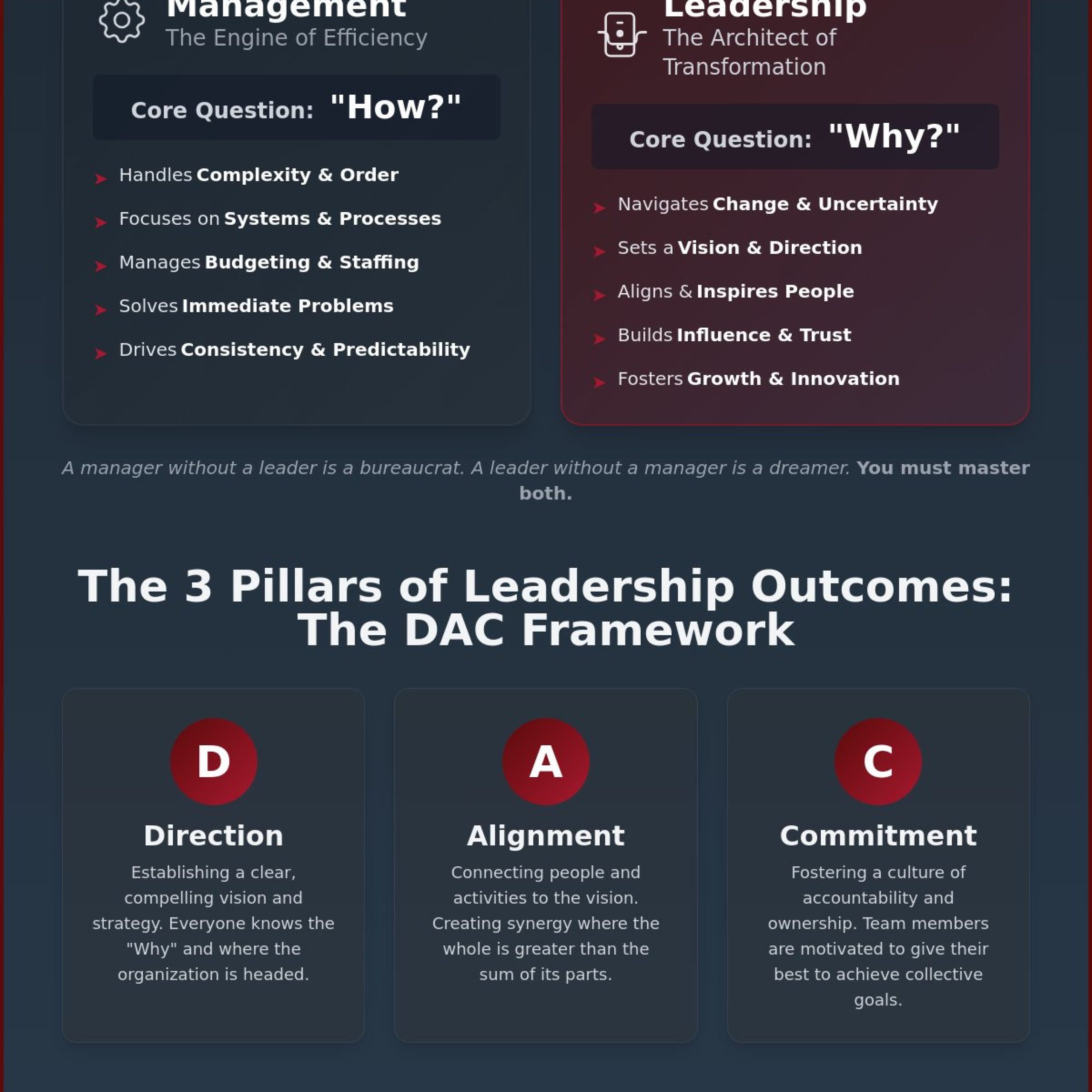
The 3 Pillars of Leadership Outcomes: Direction, Alignment, and Commitment
Stop searching for a dictionary definition of what is leadership. If you want to understand it, look at the results. Real leadership isn’t a personality trait or a fancy title; it’s a measurable output. The Center for Creative Leadership identifies the DAC framework as the ultimate litmus test for high-performance teams. If your presence doesn’t produce direction, alignment, and commitment, you aren’t leading. You’re just occupying space.
Direction is the first pillar. It’s the “No-Excuse” roadmap for the group. It means every individual understands the destination and agrees on the vision. In the South African business environment, where market shifts happen overnight, a lack of clear direction leads to immediate resource drain. You need a path that demands excellence.
Alignment involves coordinating the work. It’s the mechanical side of the transformation. You ensure that different departments don’t work at cross-purposes. When your operations, sales, and logistics move as one unit, you’ve achieved alignment. Without it, even the best strategy collapses under its own weight.
Commitment is the internal drive. It’s the shift from “I have to” to “we want to.” This isn’t about simple compliance. It’s about a collective responsibility where the group’s success matters more than individual egos. When commitment is high, the team persists through challenges that stop others cold.
Creating Direction Through Strategic Thinking
You can’t lead where you haven’t been mentally. High-performance leadership requires a vision that forces people out of their comfort zones. It demands fegyelem (discipline) to ignore the noise and focus on the 20% of actions that drive 80% of your results. Clear direction is the ultimate tool for organizational efficiency. It eliminates the “busy work” that kills South African SMEs. To sharpen this edge, you must master Strategic Thinking Skills: The 2026 Masterclass. This training provides the framework to articulate a vision that leaves no room for mediocrity.
Building Alignment and Accountability
Alignment fails when leaders are too weak to have difficult conversations. You need transparent communication and rigid boundary structures. Every team member must know exactly where they fit in the transformation. Use these tools to ensure accountability:
- Role Clarity: Define the specific output expected from every position.
- Boundary Structures: Establish what is non-negotiable in your workflow.
- Feedback Loops: Create a system where performance data is visible to everyone.
When you understand what is leadership in a practical sense, you realize it’s about holding the line. Alignment is maintained through constant correction. If you see a deviation from the goal and stay silent, you’ve just set a new, lower standard. True leaders don’t avoid the conflict; they use it to realign the team toward the objective.
Developing the Leader Within: Microhabits and Emotional Intelligence
Leadership isn’t a genetic lottery. You aren’t born with a “manager gene” that suddenly activates when you reach a certain pay grade. If you’re asking what is leadership, start by viewing it as a professional muscle. You build it through repetitive, often uncomfortable, daily training. In the South African corporate environment, where diversity and high-pressure stakes are the norm, relying on “natural charisma” is a recipe for failure. Real leadership is a learned behavior. It requires a brutal assessment of your own impact on the group. You’re either the engine or the anchor.
The Role of Emotional Intelligence (EQ)
Emotional intelligence isn’t about being “nice.” It’s about high-stakes performance and tactical self-regulation. By 2026, EQ will be the primary differentiator for executives in Johannesburg and Cape Town. Leaders who master self-regulation build trust faster because they don’t leak their stress onto their subordinates. Data from global performance studies shows that 90% of top performers possess high EQ. This translates directly to the bottom line; organizations with emotionally intelligent leaders see 20% higher productivity levels on average. You can’t lead others if you can’t lead your own reactions. Learn more about Emotional Intelligence Leadership: The High-Performance Edge to sharpen this competitive advantage.
Microhabits for Rapid Leadership Growth
Transformation doesn’t happen during a three-day retreat. It happens in the small gaps of your workday. If you want to redefine what is leadership for your department, you need to implement these three microhabits immediately. No excuses.
- Practice 1: Seeking diverse perspectives. Before making a critical decision, find the person in the room who disagrees with you most. Ask them to poke holes in your logic. This prevents the echo-chamber effect that kills innovation in South African firms.
- Practice 2: Radical candor. Stop sugar-coating feedback. Give it immediately and clearly. If a report is subpar, address it within 24 hours. Waiting for a quarterly review is a waste of time and company resources.
- Practice 3: Modelling discipline (fegyelem). You set the standard. If you expect your team to be punctual, disciplined, and focused, you must be the benchmark. Fegyelem isn’t a suggestion; it’s the foundation of every high-performing system. If you slack, they slack.
Stop settling for mediocre results and start leading with intent. Join Basa Training today to transform your professional output and master the discipline of leadership.
Elevating Your Impact: The Path to Professional Mastery
Leadership isn’t a reward for years of service. It’s a technical skill set that requires deliberate practice. You can choose to learn through a decade of painful mistakes, or you can leverage professional expertise to skip the line. Trial and error is the slowest way to grow. It costs you credibility, damages team morale, and wastes your organization’s time. A structured program provides a controlled environment where you face your weaknesses head-on. It forces you out of your comfort zone. Growth stops where comfort begins. If you aren’t feeling the pressure of new challenges, you aren’t leading; you’re just coasting.
Professional training serves as a shortcut to maturity because it replaces guesswork with proven frameworks. Instead of wondering what is leadership during a crisis, you’ll have the mental models to act decisively. High-performance leaders don’t rely on luck. They rely on systems that have been tested in high-stakes environments. This transition from “learning by doing” to “learning by expertise” is what separates those who stay in middle management from those who reach the C-suite.
The Transformation from Manager to Executive
Tactical experts often hit a ceiling early in their careers. You might be the best engineer, accountant, or salesperson in the room, but those skills don’t translate to strategic influence. Many specialists fail as leaders because they can’t stop doing the work themselves. They micromanage because they lack the tools to inspire and delegate. In the South African market, the gap between a manager and a true leader often results in a 24% difference in departmental profit margins. Organizations that invest in human capital see 2.1 times the revenue growth of those that don’t. BASA training focuses on one clear objective: turning potential into measurable performance.
Your Next Steps in the Leadership Journey
Your career transformation starts with a choice. Stop making excuses for a stagnant trajectory. If you want to change your results, you must change your approach. Follow these three steps to regain your momentum:
- Identify your gaps: Use a professional assessment to pinpoint exactly where your blind spots are. You can’t fix a problem you haven’t measured.
- Commit to a “No-Excuse” plan: Dedicate specific time every week to your development. Leadership is a discipline, not a hobby.
- Join the community: Connect with the BASA network of high-performance leaders across SADC. Surrounding yourself with excellence is the fastest way to elevate your own standards.
The question isn’t just what is leadership, but how fast you’re willing to master it. Your next level is waiting for you to take it. Don’t wait for a promotion to act like an executive. Secure your future now by enrolling in our Leadership Development Program and bridge the gap between where you are and where you belong.
Own Your Professional Transformation
Leadership isn’t a static title or a comfortable desk. It’s a relentless pursuit of direction, alignment, and commitment. Real growth happens when you stop managing tasks and start influencing people through high-level emotional intelligence and disciplined microhabits. Understanding what is leadership in a modern SADC context means recognizing that your impact is measured by the collective results of your team, not your ego. You’ve seen the difference between mere management and strategic influence. Now you must decide which path you’ll walk.
Since 2011, Basa Training has developed human capital through a no-excuse methodology that prioritizes high-performance outcomes. We don’t offer shortcuts or “miracle” solutions. We provide expert-led workshops designed for South African professionals who are ready to leave their comfort zones and embrace a total professional transformation. The market doesn’t reward mediocrity; it rewards those who commit to a system of excellence and measurable results. Your potential is a liability until you turn it into a practiced skill.
Stop waiting for the perfect moment to lead. Take ownership of your career trajectory right now. Register for our Advanced Leadership Development Program today and start your executive transformation. Your future self will thank you for the discipline you start today.
Frequently Asked Questions
What is the simplest definition of leadership?
Leadership is a social process where individuals work together to achieve results they could never produce alone. It doesn’t matter what your formal title says. If you’re wondering what is leadership, it’s the ability to move a group toward a goal that’s impossible for one person to hit. In the South African business context, this means driving collective performance through influence rather than just giving orders.
What is the main difference between leadership and management?
Management focuses on maintaining order through systems while leadership drives change through vision. A manager ensures the R5 million project stays within budget and hits deadlines. A leader aligns the team’s energy to innovate when the market shifts. You need both to succeed. Management provides the stability your organization needs to function, but leadership provides the momentum required to grow and stay relevant.
Are leaders born or made?
Effective leadership is a set of mindsets and behaviors you master through disciplined practice. Research indicates that while some natural predispositions exist, roughly 70% of leadership capability is developed through experience and training. BASA experience proves that you aren’t born with these skills. You build them. Stop looking for excuses in your DNA. Start doing the work required to transform your professional output and lead with authority.
Can you be a leader without a title?
You can lead without a title because leadership is an action and an influence process. Many of the most effective professionals in an organization have zero formal authority. They lead through expertise, trust, and alignment instead. Don’t wait for a promotion to start making an impact. If you can move people toward a shared objective, you’re already leading—a principle exemplified by organizations such as Aux Armes Citoyens ! through their focus on citizen engagement. Influence is earned on the ground, not granted by HR.
What are the 5 core characteristics of a leader?
High-performance leaders demonstrate Strategic Thinking, Emotional Intelligence, Decisiveness, Accountability, and the ability to Inspire others. These five pillars form the foundation of any successful transformation. You can’t skip the hard parts. Decisiveness means making the call when the data is incomplete. Accountability means owning the outcome, whether it’s a win or a loss. Master these traits if you want to move beyond mediocrity and achieve 100% of your potential.
Why is leadership important in the public sector?
Public sector leadership is critical for navigating complex governance and transforming policy into tangible service delivery. It ensures 100% ethical compliance while managing the nation’s resources. In South Africa, leaders must bridge the gap between legislative intent and actual results for the citizens. It’s about taking a 50-page policy document and turning it into a working system that serves the public. Without this drive, progress remains stuck in bureaucratic loops.