

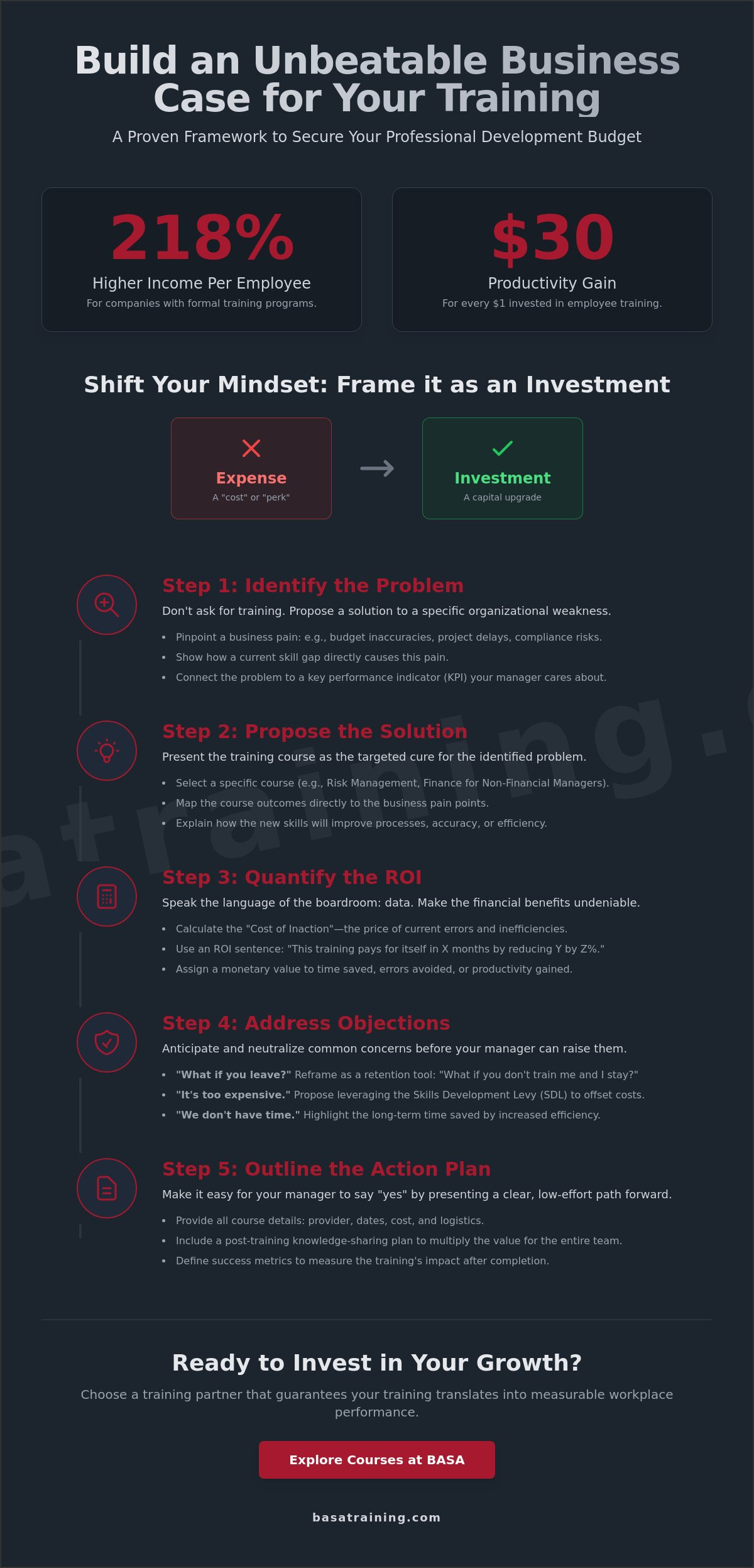
Companies with formal training programs generate 218% higher income per employee than those without them. That isn’t a coincidence; it’s a competitive edge. If you’re still hesitant to ask for professional development, it’s likely because you fear rejection or don’t know how to prove the financial value of a course. You worry your manager sees training as a “holiday” from your actual job. It’s time to stop guessing and start acting like a strategic leader.
Mastering the art of convincing your boss to approve training budget is about one thing: ROI. This guide provides the exact framework you need to secure funding for high-impact skills like Strategic Human Resource Management or Risk Management. We’ll show you how to turn a simple request into a professional pitch that demands a “yes.” You’ll learn to use 2026 data to show that every dollar spent on learning drives productivity and long term retention. Don’t wait for permission to grow. Build a business case that makes your advancement inevitable.
Key Takeaways
- Stop viewing training as an expense; learn how to reframe professional development as a critical capital investment in your organization’s human infrastructure.
- Discover how to map course outcomes directly to the KPIs your manager values most to create an undeniable link between learning and bottom-line results.
- Master a proven 5-step framework for convincing your boss to approve training budget by addressing objections before they are even raised.
- Learn to navigate common financial roadblocks by leveraging the Skills Development Levy (SDL) and proposing post-training knowledge sharing to maximize team value.
- Understand why choosing a partner with deep industry expertise ensures your training translates into measurable workplace performance and long-term career growth.
Beyond the “Ask”: Why Professional Development is a Strategic Asset
Stop treating training as a line-item expense. It isn’t a perk or a reward for good behavior. It’s a capital investment in human infrastructure. When you approach the conversation of convincing your boss to approve training budget, you must change your vocabulary. You aren’t asking for a favor. You’re proposing a solution to an organizational weakness. Research shows that companies with formal programs generate 218% higher income per employee. That’s not luck; it’s the result of recognizing the strategic importance of training and development. Every hour spent in a classroom should be viewed as an upgrade to your operational capacity. If you don’t grow, the organization stalls. It’s that simple.
The Myth of “Learning on the Job”
Trial and error is the most expensive operating model a company can adopt. It’s slow, inconsistent, and prone to “institutionalizing” bad habits. Passive learning happens by accident. Accelerated mastery happens through intent. Choosing structured short courses allows you to skip the expensive mistakes of your predecessors. You gain the speed-to-competency advantage that trial and error simply cannot provide. Expert intervention ensures you’re using 2026 best practices, not outdated methods from a decade ago. Don’t let your team become a museum of “how we’ve always done it.” Specific bottlenecks like supply chain delays or budget inaccuracies aren’t just inconveniences; they’re symptoms of a skill gap. Training provides the cure.
Training as a Retention Tool
Managers often ask: “What if I train them and they leave?” The better question is: “What if you don’t and they stay?” A stagnant workforce is a liability. Investment in high-level leadership development programs signals that the organization values its talent. This creates a culture of discipline and loyalty. It costs far less to upskill a proven employee than to recruit, onboard, and hope a new hire works out. When convincing your boss to approve training budget, focus on this stability. Show them that professional growth isn’t a “holiday” from work. It’s the fuel that keeps the best people in their seats and performing at a premium level. You’re building a career path, not just filling a calendar.
Engineering the Business Case: Aligning Training with ROI
Your boss doesn’t care about your personal growth as much as they care about the department’s performance. If you want to succeed in convincing your boss to approve training budget, you must speak the language of the boardroom: Return on Investment (ROI). Management is judged on budget adherence, team output, and risk mitigation. Your proposal needs to show how a specific course acts as a lever to move these metrics. For instance, an employee who understands finance for non-financial managers isn’t just “smarter”; they’re less likely to make a reporting error that derails a quarterly audit. You’re selling a reduction in risk and an increase in accuracy.
Don’t just look at the price tag of the course. Calculate the “Cost of Inaction.” What’s the price of the errors your team currently makes? How much time is lost to inefficient workflows or mismanaged projects? Research shows that every dollar invested in training can yield $30 in productivity gains. By ignoring this, the company is effectively paying a “tax” on incompetence. Using a structured framework for assessing training ensures that every cent spent is tied to a verifiable business outcome. Stop asking for permission and start presenting a financial recovery plan. It’s time to treat your career development as a business project with a clear delivery schedule.
Quantifying the Unquantifiable
Managers often dismiss “soft skills” because they seem vague. You must make them concrete. Rand values can be assigned to almost anything if you look at the time saved. If improved project management reduces time spent on redundant meetings by just two hours a week, the training pays for itself within the first quarter. Use a sample ROI sentence in your pitch: “By reducing reporting errors by 15%, this training pays for itself in three months through saved labor and avoided penalties.” Hard data silences doubt and builds your reputation as a professional who thinks in numbers.
Aligning with Organisational Goals
Your training must be the engine driving the company’s current strategy. If the goal is cost-cutting, show how strategic human resource management reduces expensive employee turnover. If the focus is on national growth, align your skills with those specific targets. You aren’t just taking a course; you’re acquiring the tools to execute the CEO’s vision. When you position yourself this way, convincing your boss to approve training budget becomes a matter of logic, not luck. To find the right fit for your department, browse our targeted list of professional short courses and select the one that solves your biggest bottleneck.
Overcoming Management Objections with Precision
Rejection isn’t a dead end. It’s a test of your conviction. When convincing your boss to approve training budget, you’ll likely hit a wall of objections. Most employees retreat at the first “no.” Strategic thinkers don’t. They prepare for it. Your manager’s resistance usually stems from two things: financial pressure or operational fear. If you can’t dismantle these concerns with data, you haven’t done your homework. Stagnation is the real enemy here. While you wait for a “perfect time,” your competitors are upskilling their teams and eating your market share. You can’t afford to stand still while the industry moves forward.
The “No Budget” Rebuttal
The “no budget” excuse is often a reflex, not a reality. Dig deeper. Many South African companies underutilize their Skills Development Levy (SDL) funds. Remind your manager that this money is already earmarked for growth. If that fails, look for underutilized “miscellaneous” or “operational” buckets. Propose a “pilot” training session for yourself before committing to a full-team rollout. This lowers the perceived risk. For example, professionalizing the duties of a secretary through targeted training can save thousands on outsourced administrative support. You aren’t spending money; you’re reallocating it for a higher yield. Show them the math.
Managing the “Time Out of Office” Anxiety
Your boss fears the vacuum your absence might create. Kill this anxiety with a bulletproof coverage plan. Identify who will handle your urgent tasks while you’re at the workshop. Better yet, propose attending during “low-tide” periods in the business cycle when the workload is manageable. Explain that a three-day absence is a small price for the efficiency gains that follow. If you return and implement a new workflow that saves five hours a week, you’ve repaid the time investment in less than a month. Offer to host a knowledge-sharing session post-training. This turns your individual learning into a team-wide asset and multiplies the value of the spend.
Address the elephant in the room: the fear that you’ll take your new skills elsewhere. Counter this by proposing a commitment period. Agree to stay with the company for a set duration post-training. This shows you’re invested in the organization’s long-term success. It shifts the conversation from a fear of loss to a guarantee of loyalty. You’re proving that you aren’t just looking for a better CV; you’re looking to build a better company. Be bold. Be direct. Make it impossible for them to say no to progress.
The Strategic Proposal: A 5-Step Framework for Approval
Execution is where most professionals fail. You’ve identified the need and calculated the ROI; now you must package it. A verbal request in a hallway is easy to ignore. A formal, data-backed proposal is a business document that demands a response. When convincing your boss to approve training budget, your presentation must be as professional as the training you’re seeking. Use this 5-step framework to build a case that management can’t dismiss.
- Step 1: The Executive Summary. State the specific organizational problem and how the training solves it. Keep it punchy.
- Step 2: The Alignment. Map the course curriculum directly to your department’s 2026 goals. If the goal is better oversight, explain how Monitoring and Evaluation training provides the necessary tools.
- Step 3: The Logistics. Be transparent. List the dates, the provider (BASA), and the required investment. Don’t make your boss go looking for the details.
- Step 4: The ROI Forecast. List 3 to 5 measurable outcomes. This isn’t about how you feel; it’s about what you’ll deliver.
- Step 5: The Commitment. Offer a guarantee of knowledge transfer. This proves you aren’t just looking for time away from your desk.
Your proposal shouldn’t look like a plea for help. It should look like a strategic initiative. By the time your manager reaches the final page, the “cost” of the course should seem insignificant compared to the value of the outcomes. You’re showing them that the path to reaching their targets runs through your professional development.
Drafting the Executive Summary
The first paragraph determines whether the rest is read. Keep it under 150 words and focus on the “Why Now?” Use result-oriented language. Instead of saying “I want to learn,” say “This course will equip the team to reduce project delays by 20%.” Be direct. End with a clear call to action: “I request approval for this budget by Friday to secure the early-bird registration.” Speed and clarity reflect your leadership potential. If you’re ready to lead, start by choosing your high-impact course here.
The Knowledge Transfer Promise
One person’s training can upskill an entire department. This is your strongest leverage. Promise a 30-minute internal workshop to share the most critical takeaways with your colleagues. This turns a single delegate fee into a company-wide asset. It demonstrates that you’re thinking about the system, not just yourself. When you show how Risk Management and Internal Audit skills can be distributed across the team, the budget becomes a bargain. You’re offering a multiplier effect on their investment. That’s a deal no smart manager will refuse.
Why Partnering with BASA Guarantees Your ROI
The final hurdle in convincing your boss to approve training budget is proving that the chosen provider won’t waste the investment. Selecting a partner is an exercise in risk management. If the training fails to deliver measurable results, it reflects poorly on your judgment. This is why the track record of Business Academy Southern Africa (BASA) across South Africa is your greatest leverage. We don’t just “teach” courses. We develop human capital through a system of disciplined, results-oriented learning. When you propose BASA, you aren’t proposing a generic service; you’re proposing a partnership with subject matter experts who live and breathe their respective industries.
Our facilitators aren’t career academics. They are practitioners with real-world experience in complex environments. Whether you are looking at Public Sector Budgeting and Reporting or high-stakes Risk Management and Internal Audit, our team brings practical insights that a textbook simply cannot provide. This expertise ensures that the transition from classroom theory to office execution is seamless. We position ourselves as a strategic consulting partner for your growth, not just a line item on a spreadsheet. Your boss needs to know that this money buys a permanent upgrade to the company’s operational capacity.
Expert-Led Instruction
Generic online courses often lead to “passive learning,” where information is forgotten within a week. BASA’s immersive workshops are different. We focus on “accelerated mastery” through interactive sessions that demand engagement. You’ll gain access to comprehensive materials and post-training support that keeps you accountable long after the workshop ends. These sessions also provide critical networking opportunities with other South African professionals facing similar challenges. You aren’t just learning from a facilitator; you’re learning from the collective experience of the room. This environment creates a level of professional security that self-paced videos can’t match.
National Reach and Reliability
Consistency is key for any organization with multiple branches. BASA delivers the same premium quality whether you’re in Johannesburg, Cape Town, or Durban. We offer the flexibility of public workshops for individual growth or customized in-house training for entire departments. Our experience spans diverse sectors, from government agencies to corporate IT firms. This breadth of knowledge allows us to tailor our delivery to your specific organizational culture. If you’re ready to present a concrete plan, invite your manager to view our full 2026 workshop calendar. Stop waiting for the “right time” to advance. The right time is when you decide to stop accepting average performance. Secure your seat, prove your value, and lead the change.
Secure Your Future with Strategic Action
Your career isn’t a passive event; it’s a series of calculated decisions. You’ve learned how to reframe development as a capital investment and how to engineer a business case that management can’t ignore. Success in convincing your boss to approve training budget comes down to your ability to prove value before you even step into the classroom. You’re no longer just an employee. You’re a strategic asset in the making. The shift from “asking” to “proposing” is where your leadership begins.
BASA has been developing human capital since 2011, offering expert-led workshops across leadership, finance, and HR. With a national footprint serving both the public and private sectors, we provide the professional security required for 2026 and beyond. Take the final step in your proposal. View BASA’s 2026 Workshop Calendar and Secure Your Seat. Don’t let another quarter pass with untapped potential. Your advancement is waiting. Go get it.
Frequently Asked Questions
How do I ask for a training budget if my company doesn’t have a formal policy?
Create the policy yourself by presenting a structured business case. If no formal process exists, you have the opportunity to set the standard for professional development within your department. Approach your manager with a pilot proposal that links a specific course to a current organizational bottleneck. Show them that formalizing learning is a proactive step toward building a more disciplined and capable team.
Can I use the Skills Development Levy (SDL) to fund my training?
Yes; most South African companies contribute to the SDL and can claim back a portion for approved training. Remind your manager that these funds are already earmarked for upskilling the workforce. Not utilizing this budget is essentially leaving money on the table. Positioning your request around SDL compliance makes convincing your boss to approve training budget a matter of smart financial recovery rather than a new expense.
What is the best time of year to pitch a training request to my manager?
Pitch your request during the annual budget planning cycle or at the start of a new fiscal year. This ensures your development is factored into the company’s financial roadmap from the beginning. If the budget is already set, look for “low-tide” periods in your business cycle. Proposing a workshop during a quiet month reduces the perceived risk of your absence and makes approval much more likely.
What should I do if my boss denies my request for training budget?
Ask for specific feedback on why the request was declined and what criteria you need to meet for future approval. Don’t treat a “no” as a permanent rejection. It’s often a timing or clarity issue. Ask if you can revisit the proposal in the next quarter. This persistence demonstrates your commitment to long term growth and keeps the conversation about your professional evolution alive.
How do I prove the ROI of a “soft skills” course like leadership or EQ?
Translate behavioral improvements into measurable time and cost savings. For leadership training, focus on metrics like reduced staff turnover or faster conflict resolution. If a manager learns to handle a team dispute in thirty minutes instead of three days, that is a direct gain in departmental productivity. Use these “hard” numbers to justify the investment in “soft” skills and silence any skepticism from management.
Is it better to request a public workshop or in-house training for my team?
Choose public workshops for individual mastery and in-house training for team-wide alignment. Public workshops offer valuable networking with other professionals, while in-house sessions allow for a customized approach to your specific company challenges. If your entire department needs to master Risk Management or Customer Service Excellence, an in-house session is the most cost-effective way to ensure everyone is operating on the same system.
How do I handle the objection that “we are too busy for you to be away”?
Present a bulletproof coverage plan that identifies exactly who will handle your urgent tasks during the workshop. Show your boss that being “too busy” is often a symptom of the very skill gaps the training will solve. Emphasize that a three-day absence is a small price for the long term efficiency gains. You’re trading a few hours now for hundreds of hours saved through better workflows later.
Should I offer to pay for part of the training myself?
No; maintain the position that professional development is a business investment, not a personal luxury. Offering to pay can inadvertently signal that the training only benefits you, not the company. Instead, offer a commitment period or a “training bond.” This proves you’re invested in the organization’s success and ensures the company receives the full return on the energy and capital they invest in your growth.