

79% of employees report being micromanaged, and 69% have considered quitting because of it. Micromanagement isn’t a personality trait; it’s a systemic failure of your delegation protocols. If you’re currently working double hours to fix team mistakes while your own workload sits untouched, you’re not leading. You’re just a bottleneck. Avoiding micromanagement as a new leader is the only way to protect your team’s morale and your own sanity. Stop letting your fear of failure stifle your team’s growth.
You likely feel that if you don’t oversee every detail, the quality will slip. It’s a common trap for high performers who are used to being the best in the room. You’re burned out, and your team is resentful. This guide will teach you how to transition into a strategic leader by mastering delegation and building a high-trust culture. We’ll break down the 2026 framework for empowered management so you can stop monitoring over shoulders and start driving results through others.
Key Takeaways
- Break the “Expert Trap” by shifting your focus from doing the work to developing the people who do it.
- Discover why avoiding micromanagement as a new leader requires a clear distinction between defining outcomes and dictating processes.
- Implement a structured delegation protocol that matches tasks to skill levels and ensures accountability without constant oversight.
- Transform your communication by replacing intrusive check-ins with high-impact reporting cadences that respect your team’s time.
- Invest in professional leadership development to secure the long-term productivity and morale of your department.
Understanding the Expert Trap: Why New Leaders Micromanage
Micromanagement isn’t just “being involved.” It’s a management style characterized by excessive control over minor details and a refusal to delegate. According to the foundational definition of micromanagement, it stems from a lack of trust or an obsession with minutiae. For a new leader, this often feels like “ensuring quality,” but it’s actually a productivity killer. You aren’t helping. You’re hovering.
Most new managers were promoted because they were the best “doers” in the room. This is the Expert Trap. You know the technical work better than anyone, so you find it painful to watch someone else do it slower or differently. You mistake your technical expertise for leadership. Avoiding micromanagement as a new leader requires a fundamental shift: you must detach your ego from the task and attach it to the team’s growth. If you don’t, you’ll burn out while your team checks out.
Don’t confuse high standards with high control. High standards define the quality of the finish line. High control dictates every step taken to get there. You can demand excellence without breathing down someone’s neck. When you focus on control, you become the bottleneck. Your team stops thinking for themselves because they know you’ll “fix” it for them eventually. This creates a cycle of dependency that ruins morale and stalls results.
The Psychology of the “New Leader” Transition
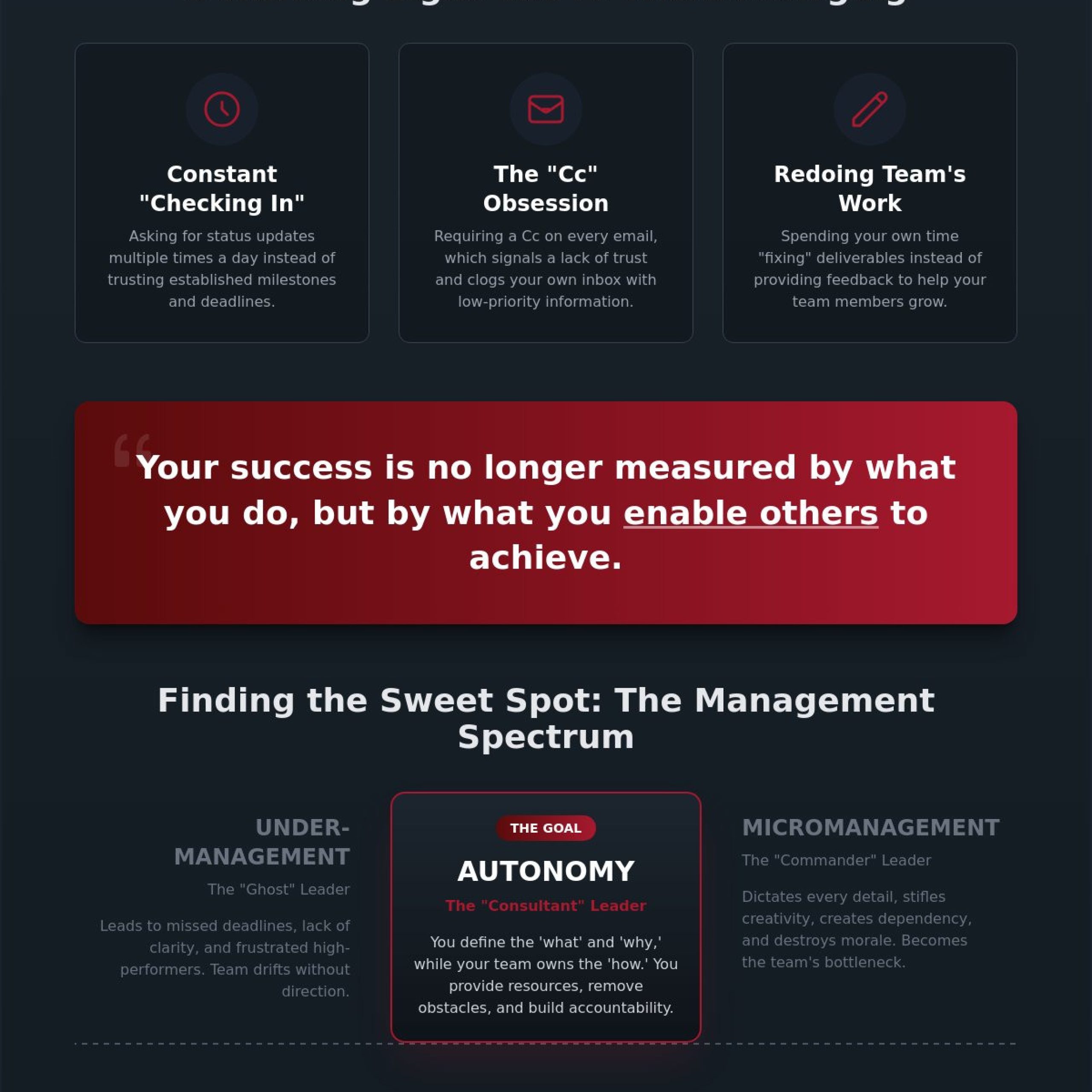
You’re likely facing an identity crisis. Your whole career, your value was tied to tangible outputs. Now, your calendar is full of meetings and your “work” feels invisible. This creates a deep fear of being held accountable for a mistake you didn’t personally make. You must accept this risk to gain the reward of scale. Your success is no longer measured by what you do, but by what you enable others to achieve.
Signs You Are Micromanaging (Even if You Mean Well)
- Constant “checking in”: You ask for status updates multiple times a day without a scheduled milestone or deadline.
- The “Cc” Obsession: You require a Cc on every internal and external email, clogging your inbox and signaling a lack of trust.
- Ghost-writing and Redoing: You spend your evenings redoing a team member’s report instead of giving them the feedback needed to fix it themselves.
Recognize these patterns early. If you continue to act as a specialist with a manager’s title, you’ll fail at both roles. True leadership is about system design, not task execution. It’s time to step back so your team can step up.
Autonomy vs. Independence: Finding the Management Sweet Spot
Management isn’t a binary choice between breathing down someone’s neck and disappearing entirely. Many fail at avoiding micromanagement as a new leader because they overcorrect. They mistake total abandonment for empowerment. This creates a dangerous vacuum where direction should be. You must find the sweet spot between these extremes. That spot is Autonomy.
Autonomy means giving your team ownership over the “how” while you strictly define the “what” and “why.” You set the destination; they drive the car. Independence is the eventual end goal. It’s the stage where a team operates with minimal intervention because the systems you’ve established are flawless. You don’t start at independence. You build toward it through consistent coaching and clear boundaries.
Success requires moving from a “Commander” to a “Consultant” mindset. A commander dictates every move. A consultant provides resources, removes obstacles, and offers expert advice when asked. If you struggle to make this mental shift, review these 12 strategies to stop micromanaging to help recalibrate your daily interactions. Stop telling. Start asking.
The Danger of the “Hands-Off” Extreme
New leaders often stop managing entirely to avoid being perceived as overbearing. This is a mistake. Under-management leads to missed deadlines and a total lack of clarity. Your team needs a leader, not a ghost. Without your guidance on priorities, high performers become frustrated and low performers drift. Finding this delicate balance is a core pillar of our leadership development program. Learn to provide the right amount of pressure without crushing creativity.
Building a Culture of Accountability
Accountability is the bridge between trust and results. When expectations are crystal clear, the need for monitoring vanishes. Implement Outcome-Based Management. Focus entirely on the final result rather than the specific steps taken to get there. If the quality meets your standards and the deadline is met, the process belongs to the employee. Mastering the balance between support and freedom is the secret to avoiding micromanagement as a new leader while maintaining peak performance.
Encourage self-correction. When a team member spots their own error and fixes it before you see it, they have achieved true autonomy. Your job is to create the environment where that is possible. If you want to scale your impact, you must trust the people you’ve hired to do their jobs. Stop watching the clock. Start watching the results.
The 5-Step Delegation Protocol for Empowered Teams
Delegation is not a sign of weakness. It is the only way to scale your impact. If you find yourself doing the work of your subordinates, you aren’t leading; you’re just an expensive technician. Avoiding micromanagement as a new leader requires a repeatable, sequential protocol that replaces your physical presence with clear systems. Follow these five steps to move from a bottleneck to a catalyst.
- Step 1: Define the Desired Outcome. Start with the “What” and the “Why.” Don’t describe the steps. Describe the finish line. If the team understands the purpose, they’ll find the best path.
- Step 2: Match the Task to the Skill Level. Assess your team objectively. Assigning a high-stakes project to an untested junior is negligence, not delegation. Match the complexity of the task to the demonstrated competence of the individual.
- Step 3: Establish Clear Boundaries and Resources. Tell them what tools they have and what the budget is. They need to know their sandbox’s limits before they can play in it.
- Step 4: Set a “Reporting Back” Schedule. This is the most critical step for avoiding micromanagement as a new leader. Stop the intrusive “checking in” emails. Instead, agree on specific milestones where they present their progress to you. This puts the burden of communication on them, not you.
- Step 5: Provide Feedback and Conduct a Debrief. Once the task is complete, don’t just move on. Analyze what worked and what didn’t. This is where the actual growth happens for your team.
Selecting the Right Tasks for Delegation
You cannot delegate everything. Sensitive HR issues, strategic vision, and final budget approvals must stay on your desk. Use a simple matrix to identify low-risk, high-learning tasks for your junior staff. These are the perfect training grounds. For those managing larger, more complex team structures, integrating these protocols into your strategic human resource management ensures that performance is driven by systems, not personality. Focus your energy where only you can add value.
Setting Boundaries: The “Freedom within a Framework” Concept
Empowerment doesn’t mean a lack of rules. It means having the “Non-Negotiables” clearly defined. These include deadlines, quality standards, and budget caps. Once these are set, step back. Allow your team to solve problems creatively within that framework. Freedom within a Framework is the ultimate tool for 2026 organizational efficiency, as it provides the safety of structure with the speed of autonomy. If the result meets the standard, their method is irrelevant. Respect their process to earn their results.
Replacing “Checking In” with Strategic Communication
“Just checking in” is often the most destructive phrase in a new manager’s vocabulary. It signals anxiety and a profound lack of trust. To succeed in avoiding micromanagement as a new leader, you must replace these ad-hoc interruptions with a rigorous “Reporting Back” system. This shifts the burden of accountability from your shoulders to your team’s. They shouldn’t wait for your nudge; they should own the update. When you stop chasing people for answers, they start taking pride in providing them.
Visibility doesn’t require hovering. Modern leadership in 2026 relies on digital dashboards and project management tools to provide real-time data on progress. Use them. If the dashboard indicates a project is on track, do not send that Slack message. Trust the data you see. Reserve your verbal communication for high-impact coaching using the “Ask, Don’t Tell” method. Instead of saying “Do it this way,” ask “What’s the biggest hurdle you’re facing right now?” This forces the team to think critically and take genuine ownership of the solution.
The Power of the Scheduled Update
Reliability is the foundation of a high-trust culture. When you tell a team member, “I will see you on Thursday at 10 AM for the update, and I won’t ask before then,” you grant them the mental space to actually perform. This discipline is a gift to yourself, too. It frees you to focus on high-level strategy or your own short courses without the constant noise of minor status updates. Demand that your team brings solutions to these meetings, not just a list of problems. If they encounter a roadblock, they must also present a proposed detour.
Active Listening and Emotional Intelligence
Providing feedback without taking the task back is a skill that requires emotional discipline. If a project hits a minor snag, your instinct will be to grab the steering wheel. Resist it. Use active listening to understand the root cause of the issue before offering a suggestion. Managing your own anxiety is a prerequisite for avoiding micromanagement as a new leader. If you look panicked, your team will stop taking risks and start hiding mistakes. Use your emotional intelligence to gauge their confidence levels. Sometimes they need a mentor; other times, they just need you to stay out of the way.
Mastering these communication protocols is the difference between a stressed supervisor and a strategic executive. If you’re ready to elevate your management style, explore our Advanced Leadership and Management Skills training to build a team that delivers results without constant supervision.
Investing in Your Growth: From Micromanager to Visionary Leader
Experience is a slow teacher, and in the high-stakes environment of 2026, you don’t have time to learn by trial and error. Many managers assume that being a subject matter expert automatically qualifies them to lead. It doesn’t. Avoiding micromanagement as a new leader requires a deliberate shift from technical execution to strategic orchestration. This transition rarely happens through intuition alone. It requires formal, structured training that provides the psychological and tactical tools to let go of the “doer” identity.
The return on investment for effective management is measurable. When you stop hovering, you reduce human capital costs. Replacing a single employee can cost up to 33% of their annual salary. Since nearly 70% of workers consider leaving due to micromanagement, the financial risk of staying the course is too high. Empowered teams are 50% more productive and report 74% less stress. You aren’t just improving morale; you’re protecting the bottom line. BASA training programs are designed to bridge this exact gap for South African leaders who want to move beyond average results.
Bridging the Leadership Skill Gap
New leaders often micromanage because they feel out of their depth in other areas, such as budgeting or strategic planning. They retreat to the technical tasks they know best. To lead holistically, you must master the broader business ecosystem. For instance, our finance for non-financial managers course helps you understand the financial impact of your decisions. When you speak the language of business, you stop obsessing over how a task is done and start focusing on the value it creates. Subject matter experts make great mentors, but only those with advanced management training become visionary leaders.
Next Steps: Your Personal Development Plan
Commit to a “Micromanagement Audit” of your last work week. Identify three tasks you touched that should’ve been handled entirely by your team. Ask yourself: was it a lack of trust or a lack of clear systems? The 2026 corporate landscape demands continuous learning. Don’t let your career plateau because you refuse to evolve. Your journey from a “Star Player” to a “Star Maker” begins with a decision to stop doing and start leading. Attend a BASA workshop today and transform your management style from intrusive to inspirational. The work starts now.
Take Control by Letting Go: Your Leadership Evolution Starts Now
Your team’s performance is a direct reflection of your ability to step back. True leadership requires you to abandon the comfort of the “Expert Trap” and embrace the discipline of systems. You’ve learned that delegation is a structured protocol, not a loss of control. By replacing intrusive check-ins with strategic reporting schedules, you grant your team the autonomy they need to deliver exceptional results. Mastering the art of avoiding micromanagement as a new leader is the only way to scale your impact and prevent burnout.
Since 2011, BASA has been developing human capital across South Africa with expert-led instruction rooted in real-world experience. We provide comprehensive professional development solutions that turn high-performers into visionary executives. Don’t let your technical skills hold your leadership potential hostage. Master the art of leadership with BASA’s Advanced Management Workshops and start building a team that doesn’t just work, but thrives. The transition from star player to star maker is challenging, but the ROI on your growth is limitless. Step up and lead.
Frequently Asked Questions
What is the main cause of micromanagement in new leaders?
The primary cause is usually the Expert Trap. Your identity is still tied to technical tasks because that is how you earned your promotion. You feel a sense of loss when you aren’t the one doing the work. This leads to a fear that quality will drop without your direct intervention. Success in avoiding micromanagement as a new leader starts by recognizing that your value now comes from enabling others.
How can I tell if I am micromanaging my team?
You’re likely micromanaging if your team stops making decisions without asking you first. Other signs include requiring a Cc on every internal email or spending your evenings redoing someone else’s report. If you’re working double hours while your team waits for your “final check” on everything, you’re a bottleneck. Your presence should accelerate work, not stall it. If the team feels paralyzed, you are the reason.
What is the difference between micromanagement and being detail-oriented?
Detail-oriented leaders care about the quality of the final result. Micromanagers care about the specific steps taken to get there. A detail-oriented leader sets high standards and checks against them at agreed milestones. A micromanager dictates the font size, the email tone, and the order of operations. One builds excellence through standards. The other stifles efficiency through unnecessary control. Focus on the “what,” not the “how” of the task.
How do I trust my team if they have made mistakes in the past?
Trust is built through a structured delegation protocol, not blind faith. Start by assigning low-risk tasks where a mistake won’t sink the project. Use these as training opportunities. Set clear boundaries and non-negotiables from the start. If mistakes happen, use a debrief to analyze the system failure rather than the person. Avoiding micromanagement as a new leader means trusting the process you’ve built to catch errors before they become disasters.
Can micromanagement be a good thing in certain situations?
It’s only acceptable during a genuine crisis or when training a completely inexperienced employee on a high-stakes task. In these rare cases, directive management ensures safety and compliance. However, this must be a temporary phase. If you’re still dictating every move after the crisis has passed or the employee has learned the basics, you’ve reverted to a destructive management style. It will eventually drive away your top talent.
What are the first three steps to stop micromanaging today?
First, audit your calendar and identify tasks you should delegate immediately. Second, establish a “Reporting Back” schedule to replace ad-hoc check-ins. Third, define the desired outcome for every project and let the team decide the process. These steps move you from a commander to a consultant. Stop watching the clock and start watching the milestones. Change your focus from activity to achievement to see real growth.
How does micromanagement affect team productivity in the long term?
It creates a culture of learned helplessness. Productivity drops because employees stop taking initiative, knowing you’ll eventually change their work anyway. It leads to high turnover and burnout for both you and your staff. You cannot scale a department if every single decision must pass through your desk first. Long-term success requires a team that takes ownership. If you don’t let them own their work, they won’t own the results.
Is it micromanagement to ask for daily updates on a high-priority project?
It depends on the execution. If the daily update is a scheduled, five-minute stand-up meeting, it’s a legitimate project management tool. If you’re sending multiple “Where are we on this?” messages throughout the day, it’s micromanagement. High-priority projects require visibility, but that visibility should come from dashboards or scheduled reports. Respect the “Freedom within a Framework” concept to keep the project moving without suffocating your team’s creativity.