

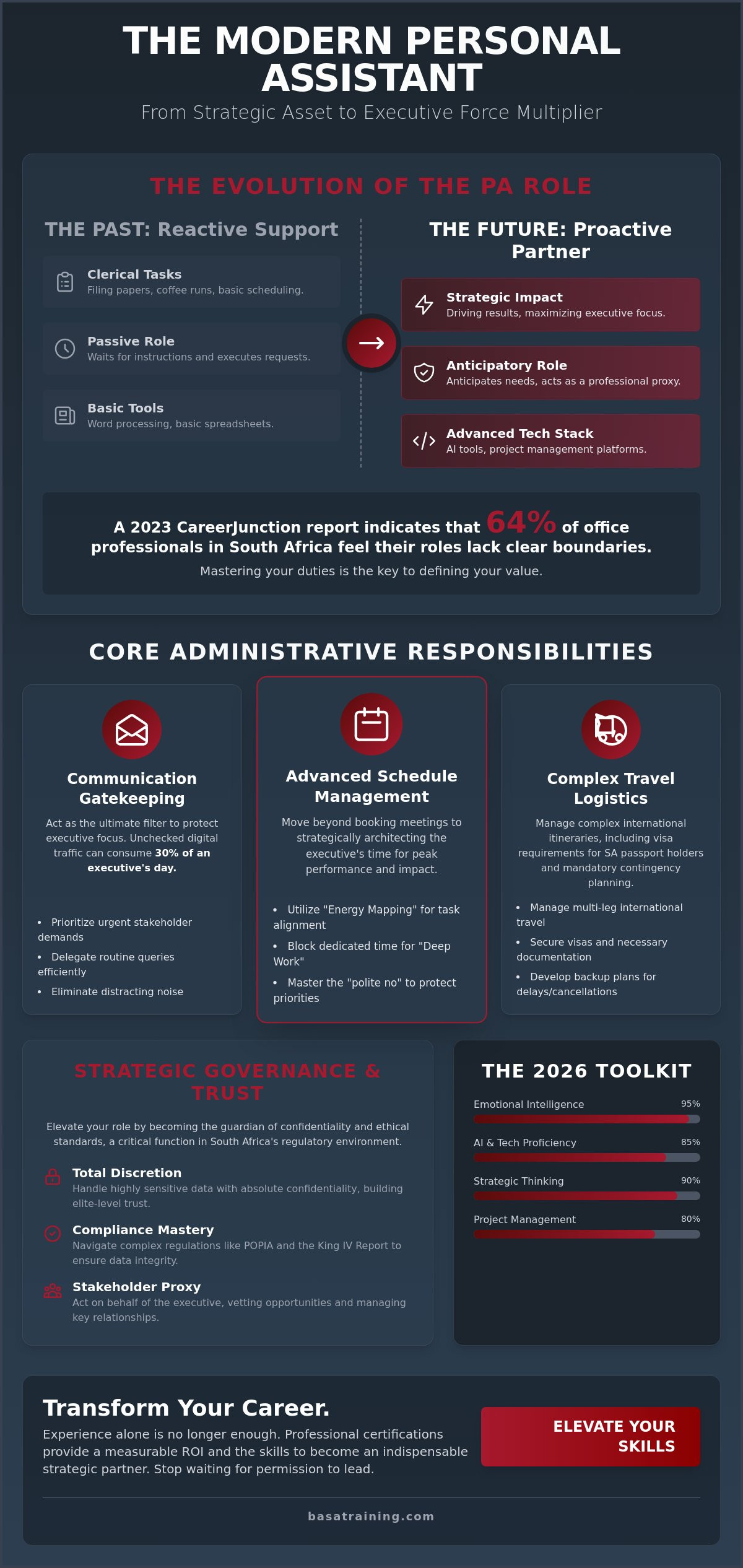
What if your executive viewed you as their most valuable strategic asset rather than just the person who books their Uber? You likely feel like your day is a chaotic cycle of coffee runs and calendar management. It is frustrating to work as a glorified errand runner when you have the capacity to drive real business results. You are not alone. A 2023 CareerJunction report indicates that 64% of office professionals in South Africa feel their roles lack clear boundaries. Mastering your personal assistant duties is the only way to break this cycle and demand the professional respect you deserve.
You know that being busy isn’t the same as being effective. This guide provides the comprehensive list of personal assistant duties required to transition from basic administrative support to a high-impact strategic partner. We will break down a professional responsibility checklist, strategies to make yourself indispensable, and the specific pathways to increase your salary in the local market. Stop waiting for permission to lead. It is time to transform your role into a powerhouse career and start commanding the ZAR value you are actually worth.
Key Takeaways
- Learn how to transition from a reactive clerical role to a proactive force multiplier that drives executive leadership and strategic decision-making.
- Master modern personal assistant duties by implementing sophisticated calendar management techniques that prioritize high-impact “deep work” over constant interruptions.
- Future-proof your workflow by integrating AI-driven tools and collaborative project management platforms to replace outdated manual processes.
- Establish elite-level trust through strategic governance, handling sensitive data with total discretion while acting as a professional proxy for stakeholders.
- Discover why experience alone is no longer enough and how professional certifications provide a measurable career ROI in the South African market.
The Evolution of Personal Assistant Duties in the Modern Workplace
Forget the outdated image of the passive secretary. By 2026, the modern Personal Assistant has become a strategic force multiplier for executive leadership. This isn’t about fetching coffee or filing papers. It’s about high-stakes alignment where personal assistant duties center on maximizing the executive’s reach and impact. You are the architect of their schedule and the filter for their focus. The Personal Assistant is the ultimate guardian of executive productivity, standing as the final line of defense against chaos and inefficiency.
The evolution of the modern assistant reveals a massive shift from reactive clerical work to proactive decision-making support. Admin isn’t a dirty word. It’s a critical business function. Without a disciplined administrative system, even the most brilliant CEO will drown in noise. The transition requires a total transformation in mindset. You don’t wait for instructions; you anticipate needs before they surface. You own the system to ensure the executive can lead without distraction.
The Distinction Between a PA and an Executive Assistant
Scope defines the difference. While an Executive Assistant often manages a broader business unit or entire department, the PA focuses on the individual principal. You are the proxy. You make calls, vet opportunities, and decide who gets access. This isn’t just task-oriented work. It’s a strategic partnership where you exercise authority on behalf of the leader. You move from simply executing tasks to leading the executive’s professional environment.
Why the Role is Expanding in South African Corporates
South African businesses operate in a high-pressure, complex regulatory environment. Compliance with the King IV Report and the Protection of Personal Information Act (POPIA) requires advanced administrative skills to ensure data integrity and ethical governance. The demand for PAs who can maintain organizational culture while managing communication flow is surging across Johannesburg and Cape Town corporate hubs. You need a blend of technical proficiency and high emotional intelligence. In a market where 90 percent of business success relies on effective execution, your ability to maintain discipline and systemize personal assistant duties is the ultimate competitive advantage. There’s no room for excuses, only results.
Core Administrative Responsibilities: The Foundation of Synchronization
Operational excellence depends on structural integrity. Mastering core administrative responsibilities is not about performing busywork; it is about creating a vacuum where an executive can lead without distraction. In South Africa’s high-pressure corporate environments, personal assistant duties have evolved from simple clerical support into tactical gatekeeping. You are the filter. You decide what reaches the desk and what gets discarded. This requires a 100% commitment to precision and a refusal to accept mediocrity in the daily grind.
Communication gatekeeping is your primary weapon. High-volume digital traffic can consume 30% of an executive’s day if left unchecked. You must categorize every incoming stream. Prioritize urgent stakeholder demands, delegate routine queries, and delete the noise. Your goal is maximum executive focus. When the foundation is solid, the leader can think. When the foundation is weak, the entire structure collapses under the weight of trivial tasks.
Complex travel logistics demand more than just booking a flight from OR Tambo to London. You manage multi-leg itineraries that include ground transport, visa requirements for South African passport holders, and tight 45-minute connection windows. Contingency planning is mandatory. If a flight is delayed, you must have a secondary route and a rescheduled meeting plan ready before the executive even lands. This level of foresight separates a clerk from a partner.
Advanced Diary and Schedule Management
Stop filling calendars with back-to-back meetings. Strategic scheduling uses energy mapping to align tasks with the executive’s peak performance windows. Reserve the first three hours of the day for deep work. Schedule high-stakes negotiations when their mental clarity is at 100%. Handling conflicting priorities requires a “polite no” that protects the executive’s time without burning bridges. If a request does not align with the quarterly KPIs, it does not get a slot. It is that simple. You can learn to refine these high-level coordination skills through disciplined professional development.
Information Management and Reporting
Data is useless without context. Your job is to transform 50-page reports into actionable executive briefs. These summaries must highlight three things: the core problem, the financial impact in ZAR, and the required decision. Never let an executive walk into a room unprepared. All meeting materials, including minutes from previous sessions and bios for new contacts, must be delivered 24 hours in advance. Rapid information retrieval depends on a digital filing system that anyone in the inner circle can navigate in under 15 seconds. Efficiency is the only metric that matters here.
- Standardize all professional correspondence to reflect a unified brand voice.
- Audit digital filing structures every 30 days to remove redundancies.
- Implement a “zero-inbox” policy for the executive’s primary account by 17:00 daily.
Strategic Governance, Confidentiality, and High-Level Coordination
Effective personal assistant duties extend far beyond basic administrative support. You’re the strategic filter for the executive office. This role requires you to manage small-to-medium projects from inception to completion without constant supervision. You don’t just track tasks. You own the outcome. Whether it’s a R500,000 corporate rebranding or a departmental restructuring, you ensure every moving part aligns with the 2024 organizational goals. You must maintain a bird’s-eye view of the company’s trajectory. If a project doesn’t serve the bottom line, it’s your job to flag it. Efficiency isn’t about doing more. It’s about doing what matters.
The PA as a Stakeholder Liaison
You’re the face of the executive. When you speak, stakeholders hear the CEO’s voice. Building relationships with board members and external partners requires a blend of diplomacy and grit. You’ll often face high-pressure administrative environments where conflict is inevitable. Don’t shy away from it. Mediate with facts. Professionalism is your shield. Your ability to manage the executive’s reputation in South Africa’s competitive market determines how doors open for the firm. Timely, sharp interactions aren’t just polite. They’re tactical advantages that build long-term influence.
Maintaining Confidentiality and Compliance
Discretion is your most valuable asset. In the South African business context, you must navigate the Protection of Personal Information (POPI) Act with surgical precision. Non-compliance isn’t just a mistake; it’s a legal catastrophe that can lead to fines reaching R10 million or imprisonment. You’re responsible for developing secure systems for document storage and encrypted communication. This isn’t just about passwords. It’s about the “Circle of Trust.”
You’ll hear secrets that could move markets or destroy careers. Stay neutral. Office politics is a trap for the unprepared. You aren’t there to gossip or take sides in water-cooler debates. You’re there to protect the integrity of the executive office. High-level personal assistant duties demand ethical, ironclad integrity. If you can’t be trusted with a secret, you can’t be trusted with the role. Implement these protocols to ensure safety:
- Encrypted Channels: Use secure platforms for all sensitive board-level communications.
- Access Control: Audit who has access to the executive’s digital and physical files every quarter.
- Neutrality Protocol: Maintain professional distance from internal factions to preserve your role as an unbiased proxy.
Mastering these elements transforms you from a helper into a strategic partner. It’s about discipline. It’s about foresight. It’s about executing your responsibilities with the realization that you’re the backbone of the executive’s success. Don’t wait for instructions. Anticipate the need and act.
The 2026 PA Toolkit: Essential Skills and Emerging Technologies
The era of the passive administrator is over. By 2026, the Digital Native PA is an architect of efficiency, building robust systems that buy back the executive’s most valuable asset: time. You aren’t just managing a calendar; you’re engineering a high-performance environment. This requires a shift from reactive task-handling to proactive system design. Mastering personal assistant duties in this decade means becoming a power user of AI tools for scheduling, transcription, and real-time data analysis. Tools like Fireflies.ai or Otter.ai now save an average of five hours per week on manual note-taking, allowing you to focus on strategic output rather than clerical input.
Static spreadsheets are no longer sufficient for high-stakes environments. You must transition to collaborative project management platforms like Monday.com or ClickUp to maintain a single source of truth. These tools provide the transparency needed to manage complex workflows across different time zones. Efficiency isn’t a suggestion; it’s a requirement for survival in the modern corporate world.
Technical Proficiency in a Hybrid World
Hybrid work is the standard in South African business hubs like Sandton and Cape Town. You must master virtual meeting environments to ensure maximum engagement. This involves more than just “opening a link.” You are responsible for the technical integrity of the session. Cybersecurity is your next frontier. With South African businesses facing an average of 1,100 cyberattacks per week in 2023, you must implement 2FA and encrypted password management as a baseline. Automation is your leverage. Setting up Zapier or Make.com workflows to handle repetitive data entry ensures your focus remains on high-level problem-solving.
The Importance of Soft Skills and Emotional Intelligence
Technology provides the speed, but emotional intelligence provides the direction. You must anticipate needs before the executive articulates them. If you’re waiting for instructions, you’re already behind. This requires a “hard but fair” approach to office management. You are the gatekeeper. You must protect the executive’s schedule with disciplined intensity, saying no to distractions so they can say yes to growth. During a crisis, your role is to mentor the office environment through composure and rapid resolution. Composure isn’t just about staying quiet; it’s about executing a plan while others are still processing the shock.
Ready to transform your professional output and lead with authority? Start your transformation with Basa Training and master the discipline required for elite performance.
Professional Transformation: Elevating Your Career Through Training
Experience alone is a trap. In the South African corporate world, longevity doesn’t equal leverage. You need verified, high-level skills to move from the periphery to the center of power. Top-tier executives in 2026 don’t just want someone to answer phones; they want a strategic partner. If your resume only lists years of service without showing specialized growth, you’re stagnant. Stagnation is the first step toward obsolescence.
The return on investment for professional certifications is clear and measurable. Data from South African recruitment platforms like CareerJunction indicates that administrative professionals with recognized certifications earn 15% to 22% more than their untrained peers in regions like Gauteng and the Western Cape. Investing in your education isn’t a cost. It’s a capital injection into your personal brand. It’s the difference between asking for a raise and demanding one based on proven value.
Advanced Secretarial and Administrative Skills Training
Generalists are replaceable. Specialists are essential. High-level short courses designed for modern office pros bridge the gap between basic support and management. You must develop a niche in Finance, HR, or Project Management to become a true asset. Don’t just claim you’re efficient. Build a Portfolio of Evidence (PoE) that documents how you’ve optimized personal assistant duties to drive results. Show how you saved the company R40,000 in procurement or cut executive travel costs by 12% through better vendor management. If you’re serious about making this leap, advanced secretarial courses designed for executive partnership provide the structured credentials and digital governance skills that modern C-suite leaders demand.
Creating Your Personal Development Plan
Success is a system, not an accident. You need a roadmap to reach the Administrative Lead level. Start with a professional audit to identify where you’re weak. Are you struggling with budget forecasting or digital transformation tools? Be honest. Once you know the gaps, set SMART goals for 2026. Your plan should include these three pillars:
- Skill Acquisition: Master one technical skill every quarter, such as advanced data visualization or AI-driven scheduling.
- Strategic Networking: Connect with a mentor or join a professional body like the Association for Office Professionals of South Africa (OPSA).
- Performance Metrics: Quantify your personal assistant duties monthly to track your contribution to the firm’s bottom line.
The transition from assistant to leader requires a mindset shift. Stop waiting for permission to grow. Take ownership of your trajectory. If you want a seat at the table, you must bring more to it than a notepad and a pen. Train hard, specialize early, and refuse to settle for a mediocre career path.
Take Command of Your Strategic Evolution
The modern workplace doesn’t reward mediocrity. Your shift from a traditional administrator to a strategic executive partner is a necessity for professional survival in South Africa. Mastering complex personal assistant duties requires more than a tidy calendar; it demands high-level coordination, absolute confidentiality, and a mastery of 2026 digital tools. You’ve seen how the role has shifted toward strategic governance. Now, you must decide if you’ll keep pace or get left behind.
Success isn’t an accident. It’s the result of discipline and expert-led training. Since 2011, Basa Training has delivered over 15 years of human capital development across Southern Africa. Our workshops are led by real-world subject matter experts who focus on results, not theories. We provide comprehensive e-learning and in-person solutions designed to push you out of your comfort zone and into a position of authority. Stop making excuses and start building your legacy.
Master the art of executive support with our Advanced Secretarial and Administrative Skills course
The path to the top is open. It’s time to take the first step toward your transformation.
Frequently Asked Questions
What are the primary duties of a personal assistant in 2026?
In 2026, personal assistant duties center on strategic resource management and deep AI integration. You aren’t just booking flights; you’re optimizing an executive’s cognitive load by managing complex digital ecosystems. This role requires you to act as a gatekeeper for 100% of high-priority communications. Don’t settle for basic admin. You must master predictive analytics to stay ahead of your executive’s needs every single day.
How does a personal assistant differ from a secretary?
A personal assistant focuses on an individual’s success, while a secretary focuses on general office processes. Secretaries typically handle 90% of incoming calls and physical filing for an entire department. As a PA, you own the executive’s time and make decisions rather than just taking appointments. It’s the difference between following a script and writing the strategy for the day. You’re a partner, not a processor.
Do I need a specific qualification to work as a PA in South Africa?
You don’t need a specific degree by law, but 78% of South African recruiters prioritize candidates with an NQF Level 5 or higher in Business Management. Experience in the local corporate sector carries more weight than a basic certificate. Focus on building a portfolio that proves you can handle R2 million budgets or complex travel logistics across the SADC region. Results matter more than paper.
Can a personal assistant work remotely or in a hybrid setup?
Remote and hybrid setups are the new standard, with 60% of South African PA roles now offering flexible locations. You need a dedicated home office and a 100 Mbps fiber line to maintain professional standards. Use tools like Slack and Trello to ensure zero lag in your performance. Distance isn’t an excuse for poor communication; it’s a test of your discipline and tech-savviness.
What is the average salary expectation for a high-level PA?
High-level PAs in South Africa’s major hubs earn between R40,000 and R75,000 per month. Those working for C-suite executives in JSE Top 40 companies often see total packages exceeding R900,000 annually. These figures depend on your ability to handle high-pressure environments and solve problems before they reach the boardroom. Your results dictate your value, so focus on becoming indispensable to the bottom line.
How is AI changing the daily duties of a personal assistant?
AI is currently automating 45% of traditional personal assistant duties like transcription and basic scheduling. This isn’t a threat; it’s your leverage to do more in less time. Use ChatGPT and specialized AI tools to cut your admin time in half. This shift allows you to focus on high-value tasks like relationship management and strategic project oversight that no algorithm can replicate yet.
What are the most important soft skills for a PA to have?
Discretion and proactive problem-solving are the non-negotiables for any elite PA. You must maintain 100% confidentiality while navigating high-stakes corporate politics. Adaptability is your greatest asset in this role. When a flight gets canceled at 2 AM, your executive expects a solution, not a list of reasons why it’s difficult. Take total ownership of every outcome and never make excuses.
How can I transition from a junior PA to an Executive Assistant?
Transitioning to an Executive Assistant requires a mental shift from task execution to business partnership. Stop waiting for instructions and start proposing solutions based on company goals. Gain a certification in Project Management to prove you can lead initiatives independently. EAs act as a force multiplier for their executive, so show that you understand the 2024 business landscape in South Africa through your actions.